Ask around any car park after a track day and eventually you’ll hear the story: a rider grabs a handful of front brake mid-corner, the ABS pulses, the bike stands up, and suddenly they’re heading for the hedge instead of the apex. The conclusion is always the same — the ABS did this to me. It’s a story that spreads fast, gathers detail with every retelling, and is almost always wrong in the one place that actually matters: the part where ABS gets blamed for a crash it was actively trying to prevent.
So let’s ask the provocative question properly, out loud, and then answer it honestly. Is your motorbike’s ABS trying to kill you? No. It categorically is not. What follows is why — how modern cornering ABS actually works, why the real-world picture points overwhelmingly in its favour, and the small handful of genuine edge cases where it can catch an unprepared rider off guard. Understand those edge cases and you stop fighting the system that is, by any honest measure, one of the best things ever bolted to a motorcycle.
How Cornering ABS Actually Works
Traditional ABS only ever asked one question: is a wheel about to lock? It compared wheel speed against expected road speed and released brake pressure the instant a lockup looked imminent, and it did this on the assumption that the bike was upright. Cornering ABS, now fitted as standard on almost every mid-size and large motorcycle sold new, asks a far smarter question, because it has a great deal more information to work with. A six-axis inertial measurement unit — the IMU — tracks lean angle, roll rate, pitch and yaw many times a second, feeding that data to the ECU alongside wheel speed and brake pressure.
With lean angle in the equation, the system can estimate the tyre grip genuinely on offer at that specific angle, rather than assuming you’re sat bolt upright with the full contact patch available. Lean the bike over and there is simply less rubber and less vertical load resisting a locked wheel, so the system tightens its tolerances and steps in earlier and more gently than it would during upright, walking-pace braking. That is precision, not panic — the electronics are quietly recalculating your traction budget dozens of times a second and only ever spending what is actually there.
Crucially, cornering ABS does not merely stop a wheel locking. Many systems also manage lean-angle-dependent brake distribution between front and rear, and the best of them work hand in hand with lean-sensitive traction control to keep the whole chassis settled under simultaneous braking and turning loads — a job no human nervous system can do at the speed the electronics operate.
The Real-World Record: Fewer Crashes, Not More
Strip away the anecdotes and the wider picture is remarkably consistent: insurers, safety researchers and manufacturers who track long-term claims data all point the same direction. Motorcycles fitted with ABS are involved in meaningfully fewer crashes than otherwise comparable non-ABS machines, and the gap is widest in precisely the scenario riders fear most — an emergency stop that goes wrong. The reason is unglamorous but decisive: most riders, under genuine panic, brake later and harder than they believe they do, and a locked front wheel at that moment ends in a low-side almost every single time. ABS simply removes that one specific failure mode from the equation, quietly and repeatedly.
None of which means ABS makes crashes impossible, and no honest reviewer would claim otherwise. It cannot manufacture grip that genuinely isn’t there — sheet ice, a diesel spill or a wheel already airborne over a mid-corner bump are still beyond anything a computer can fix. What it reliably does is convert the single most common cause of a braking crash — an unintended front-wheel lockup — into a complete non-event, over and over, for riders who would otherwise never have felt it coming.
Where ABS Genuinely Surprises Riders
The myth doesn’t come from nowhere, though, and being straight about where cornering ABS genuinely feels strange is the whole point of this piece. Loose gravel and hard-packed dirt are the biggest offender. ABS calibration is built around a wheel-speed model that assumes a reasonably consistent, high-friction surface; on loose stones that assumption breaks down constantly, because wheel speed naturally fluctuates as small stones roll and shift beneath the tyre. The system can misread that fluctuation as an impending lockup and release brake pressure right when you wanted maximum retardation, extending your stopping distance rather than shortening it. It’s exactly why serious adventure bikes ship with a switchable, reduced-intervention off-road ABS mode — and why leaving it in road mode on a gravel track is asking for trouble.
Mid-corner trail braking is the second genuine edge case, and it tends to catch sportier riders rather than novices. Trail braking deep into a bend — carrying a trace of front brake well past turn-in — is a legitimate, widely taught technique, but it asks the system to make its lockup calculation at the exact moment lean angle, load transfer and available grip are all shifting simultaneously. Push that combination right to the edge of what the tyre can actually give, particularly on cold rubber or a greasy patch, and cornering ABS will intervene to protect the front. That intervention — a firm pulse through the lever while you’re leaned right over — can feel abrupt to a rider who wasn’t expecting it, even though the system is doing precisely what it was designed to do.
A third, smaller surprise crops up when riders swap between bikes: a rear wheel lifting slightly under very hard front braking, or an unfamiliar amount of lever pulsing compared with whatever they rode last. Neither is a fault. It’s simply a different calibration philosophy, and the fix is familiarity with your own machine, not distrust of the technology fitted to it.
Cornering ABS has never once tried to kill me — but on at least two occasions, it has very obviously stopped me killing myself.— Hana Kobayashi, Features Writer
Riding With ABS Instead Of Fighting It
The riders who get the most out of modern ABS are the ones who stop treating it as a rival fighting their inputs and start treating it as a grip calculator working on their behalf. That means braking with real intent rather than hesitation: squeeze the lever progressively and with genuine commitment in a true emergency, because the system is built to be leaned on hard, not feathered nervously. Trust the pulse when it arrives — it is information, not malfunction — and resist the urge to snap the lever shut the instant you feel it, because that instinct defeats the entire point of the system.
It also means respecting the two edge cases above rather than resenting them. Switch to a gravel or off-road ABS mode before the tarmac runs out, not after you’ve already lost the front on loose stones. And if trail braking deep into corners is part of your riding, build that habit gradually on familiar roads or a track day first, and accept that an intervention there is the electronics catching a margin you had already spent — not a machine deciding to work against you.
- Learn where your bike’s ABS modes live and switch to gravel or off-road mode before the surface changes, not after.
- Squeeze the front brake progressively and with real commitment in an emergency — ABS rewards decisive input, not hesitation.
- If you trail brake, build the technique gradually on familiar roads or a track day before pushing it near the limit.
- A firm pulse at the lever mid-corner is the system working, not failing — don’t snatch the lever shut in response.
- Spend five minutes in an empty car park learning exactly how your specific bike’s ABS feels before you ever need it for real.
- Only disable ABS if your bike offers it as a deliberate, understood option — never out of a vague sense that it’s “in the way”.
Verdict
Your motorbike’s ABS is not trying to kill you. On the balance of overwhelming real-world evidence, it is one of the most quietly effective pieces of engineering ever fitted to a motorcycle — a system that has converted countless would-be low-sides into uneventful, forgettable stops, most of which the rider involved never even registered as a near miss.
The edge cases are real, but they are narrow, well understood and entirely manageable: respect loose surfaces, build your trail-braking technique deliberately, and treat every pulse at the lever as useful information rather than betrayal. Learn those few rules and cornering ABS stops feeling like an unpredictable passenger on your motorcycle, and starts feeling like exactly what it is — the best safety net riding has ever built in.
Predicting the future of any technology is a fool’s errand, but the electric motorcycle is an unusually readable case. Almost everything that will define the next decade is already visible in prototype form, in a battery lab, or buried in a regulatory timetable somewhere. We are not waiting on some undiscovered breakthrough to make electric bikes brilliant; we are waiting on cost, chemistry and charging to grind steadily forward along curves engineers can already sketch with confidence. The interesting question is not whether the electric motorcycle wins, but how quickly, in which markets first, and what it feels like to ride when it finally does.
So rather than promising jet-packs, this is a sober look at the forces actually pulling the category forward — and the stubborn ones holding it back — over the ten years to come.
Batteries Are the Whole Story
Everything else is a footnote to the cell. The battery dictates the price, the weight, the range, the charging speed and even the handling of an electric motorcycle, so progress in chemistry is progress in every direction at once. The next decade will be defined by energy density creeping upward and, crucially, cost per kilowatt-hour falling as manufacturing scales globally. Solid-state cells, promising more energy in less space with less fire risk, hover on the horizon but remain stubbornly expensive and hard to mass-produce. The likelier near-term story is incremental: better lithium-ion packs, smarter thermal management, and clever software squeezing more usable range from the same box. Each small gain compounds, because a lighter, cheaper battery makes the whole bike lighter, cheaper and more appealing in a virtuous circle that petrol simply cannot match. Analysts expect the cost of cells to keep sliding as gigafactories multiply worldwide, and the day an electric motorcycle undercuts its petrol equivalent on both sticker price and running cost is the day the whole argument is effectively over.
Charging Standards Grow Up
Today’s electric motorcycle owner faces a mild mess of plugs, apps and payment cards inherited largely from the car world. That will not last. The next decade should bring genuine consolidation around a small number of standards, faster charging tailored to two-wheeler battery sizes, and payment that finally just works with a tap. As public infrastructure thickens and roaming agreements mature, the ritual of hunting for a compatible, functioning charger — the single biggest source of range anxiety — should fade into the same background hum that petrol forecourts occupy today. The bikes are largely ready; the network around them is the slow part, and it is finally catching up. Governments legislating for charging provision, and the sheer momentum of the electric-car rollout, mean the network expands whether or not two-wheeler makers push for it, and bikes ride along on that far larger wave of investment.
Swappable Batteries and the City
In dense Asian megacities, the future may not involve plugging in at all. Battery-swap networks, where a depleted pack is exchanged for a charged one in under a minute at a roadside kiosk, are already scaling rapidly for scooters and light commuters, led by ambitious operators across Taiwan, India and Southeast Asia. The model neatly sidesteps both charging time and the crushing upfront cost of the battery, which the rider effectively rents rather than owns. Standardised swappable packs, backed by consortiums of major manufacturers, could become the default for urban two-wheelers long before they trouble the heavyweight touring market, splitting the electric world into two very different futures. India in particular, with its vast appetite for affordable two-wheelers, could prove the decisive market, and whatever standard wins there may set the template for much of the developing world.
The winning electric motorcycle of 2035 will not be the one with the biggest battery. It will be the one you never have to think about charging at all.— Priya Anand, Technology Editor
Legacy Brands Wake Up
For years the electric charge was led by specialists and start-ups while the great combustion houses hedged their bets and protected their cash cows. That reticence is ending. Every major manufacturer now has electric concepts, patents and platforms in development, and their arrival in force will transform the market almost overnight, bringing dealer networks, servicing muscle, financing and hard-won brand trust that no start-up can conjure. When a household name puts its badge on a genuinely desirable electric flagship and stands behind it with a proper warranty, the psychological barrier for millions of cautious buyers drops in a single stroke. Their supply chains and economies of scale will also drag prices down faster than any start-up could manage alone, accelerating the whole category toward the mainstream.
- Falling battery cost per kilowatt-hour, dragging sticker prices toward petrol parity
- Consolidated, faster charging standards designed around two wheels rather than four
- Battery-swap networks dominating dense urban commuter and scooter markets
- Legacy manufacturers arriving with dealer networks, financing and brand trust
- Software and connectivity turning the bike into an updatable, personalised platform
The Sound and Feel Problem
There is one obstacle no battery chemist can solve, and it is emotional rather than technical. Motorcycling is soaked in sound, vibration and mechanical drama — the bark of a V-twin, the wail of an inline-four, the theatre of a clutch and gearbox worked in anger. Silence unsettles the enthusiast in a way it never troubles the commuter. The next decade will see manufacturers experiment with engineered acoustics, simulated shifts and haptic feedback to give electric bikes a signature character, and purists will howl that it is fake. Yet a whole generation is growing up without the petrol romance, and for them the quiet, instant surge will simply be what a fast motorcycle feels like, no apology required. Character, it turns out, is as much a habit as a sound, and habits are inherited from whatever machines a rider happens to grow up with.
Grand Prix racing has always justified its eye-watering budgets with a single promise: the technology forged under the fiercest competition on earth eventually filters down to the machines ordinary riders can buy. For decades that trickle-down was mostly about engines and frames. Today it is overwhelmingly about electronics and aerodynamics — the invisible systems that let a modern superbike deploy more than two hundred horsepower without spitting its rider into the scenery. Sit on a current Ducati Panigale V4 or a BMW M 1000 RR and you are, in a very real sense, borrowing hardware and thinking that was science fiction in the MotoGP paddock barely fifteen years ago.
The remarkable part is how completely this has happened, and how little the average buyer notices. The magic hides behind the menus. Here is what actually made the journey from the prototype grid to your driveway.
The Six-Axis Brain
The single most important piece of trickle-down technology is the inertial measurement unit, or IMU. This matchbox-sized cluster of accelerometers and gyroscopes tracks the motorcycle’s movement through space — lean angle, pitch, roll, yaw and acceleration — hundreds of times a second, and hands that live picture to the bike’s electronic brain. Once the machine knows precisely how far it is leaned over and what it is doing, every other rider aid becomes vastly smarter. MotoGP and its factory engineers drove the miniaturisation and refinement of these sensors, and by the middle of the last decade the six-axis IMU had reached flagship road bikes. It is the foundation stone; without it, cornering traction control and lean-sensitive ABS would be impossible. What once required a rack of laboratory equipment now fits neatly under the seat and costs a fraction of what the first racing units did, which is precisely why the technology was able to spread so far so quickly.
Winglets Come Down to Earth
The most visible import from the paddock is aerodynamic downforce. When Ducati provocatively bolted winglets to its Desmosedici racer, the paddock scoffed, then scrambled to copy the idea once the lap times spoke. Those carbon appendages press the front wheel into the tarmac at speed, taming the tendency to wheelie under brutal acceleration and improving stability into fast corners. Within a few short seasons the wings migrated straight onto road-going flagships. The Panigale V4 wears integrated aero fairings drawn directly from Ducati’s Grand Prix programme, and the BMW M 1000 RR carries its own M winglets — genuine functional downforce on a bike you can ride to breakfast, not merely styling theatre. The effect is subtle at legal speeds and pronounced at the pace these machines were truly built for, keeping the nose planted where an unaided litre-bike would paw at the air.
A modern superbike does not make you a better rider. It makes your mistakes survivable — and that safety net was woven, thread by thread, on the MotoGP grid.— Sam Whitlock, Racing Editor
Launch Control and the Quickshifter
Two paddock staples have become so common that riders now expect them as standard. The up-and-down quickshifter, which lets you bang through the gearbox flat-out without the clutch or throttle, began as a way to shave hundredths from a racing lap and is now fitted to bikes far down the price ladder. Launch control, which manages engine speed and wheelspin off the line for a clean, repeatable getaway, made the identical journey. On a Panigale V4 or an M 1000 RR both operate with a precision that would have shamed a factory race team a couple of decades ago, and they turn a tricky standing start into something a competent road rider can execute cleanly and consistently. A generation ago, launching a superbike hard demanded a delicate, practised clutch hand; today the electronics do the fine work, and the rider simply holds the throttle open and trusts the software to sort out the rest.
Cornering ABS and the Safety Net
Perhaps the most genuinely life-saving trickle-down is lean-sensitive, or cornering, ABS. Traditional anti-lock braking only worked reliably with the bike upright; grab a fistful of brake mid-corner and older systems could still tuck the front and pitch you off. By feeding IMU lean data into the braking algorithm, engineers created systems that modulate braking force according to how far the bike is banked over, allowing a rider to scrub off speed mid-bend without losing the front. The same IMU foundation enables slide control, engine-braking management and wheelie control, each quietly intervening thousands of times a ride. The rider feels a benign, confidence-building machine; underneath, a Grand Prix-grade computer is working furiously to keep the rubber planted. The rider rarely notices these systems working at all, which is exactly the point: the very best electronic aids are the ones that feel like natural talent rather than intrusive technology.
- Six-axis IMU: the sensor cluster that tells the bike its exact attitude in real time
- Cornering traction control and lean-sensitive ABS built on that IMU data
- Up-and-down quickshifters and launch control lifted straight from race procedure
- Aerodynamic winglets generating real front-end downforce on road flagships
- Slide, wheelie and engine-brake control smoothing the delivery of huge power
What Is Still Locked in the Paddock
Not everything has escaped the garage, and the gap is a useful reminder of just how extreme prototype racing remains. The seamless-shift gearbox, which changes ratio with no interruption of drive at all, stays largely a racing exotic on cost and complexity grounds. Sophisticated ride-height devices, which physically squat the bike for launches and top-speed runs, have been progressively restricted even within MotoGP itself and remain absent from showrooms. And the pneumatic-valve engines spinning to astronomical revolutions in the premier class are a world away from anything homologated for the road. The frontier keeps moving; today’s paddock secret is tomorrow’s brochure bullet point. History suggests it is only a matter of time and cost before some of today’s paddock exotica trickles down to the showroom as well, just as the once-radical IMU eventually did.
When aerodynamic winglets first sprouted from the fairings of MotoGP bikes, the reaction ranged from bemusement to open mockery. They looked like something bolted on by an over-enthusiastic modeller, all sharp edges and awkward carbon. A decade later, nobody is laughing. Those fins have become one of the most fiercely contested areas of Grand Prix development, absorbing millions in wind-tunnel and computational fluid dynamics work, and they have migrated onto road-going superbikes such as the Ducati Panigale V4. To understand why engineers fought so hard for them, you have to understand the specific problem a fast motorcycle faces when the throttle is pinned.
The short version is that a modern racing motorcycle makes more power than its front wheel can keep on the ground. Everything about winglets flows from that single, stubborn fact.
The Problem Aero Solves
A litre-class racing engine produces so much thrust that, under hard acceleration, the front wheel wants to lift clear off the tarmac. A rising front is slow and dangerous: it delays how early a rider can get on the power out of a corner, it makes the steering vague and nervous, and it forces the electronics to cut power to keep the bike from flipping. For decades the only answers were electronic wheelie control and the rider’s own delicate throttle hand, both of which sacrifice precious acceleration. Winglets attack the problem physically. By generating aerodynamic downforce on the front of the machine, they press the wheel down and let the rider deploy more power, sooner, with the electronics intervening less. The gain is measured in mere fractions of a second per lap, but over a full race distance those fractions decide championships, which is exactly why teams pursue them so relentlessly.
Downforce Without Wings, Then With
The principle is borrowed straight from car racing, where wings have generated downforce for half a century, but on a motorcycle it is fiendishly complicated by lean. A car’s wing works at a steady angle; a motorcycle spends much of its life banked over at sixty degrees, so a wing that presses down usefully on the straight behaves very differently through a corner. Engineers shape the winglets and the fairing so the aerodynamic load helps stabilise the bike both upright and leaned, adding front grip when hard on the brakes and steadying the machine through high-speed turns. It is a three-dimensional puzzle, and the answers are far from obvious, which is exactly why the development budgets are so vast. Wind tunnels and enormous computational-fluid-dynamics simulations now consume a huge share of a racing team’s resources, all to shape a few square inches of carbon that most spectators barely register.
People see ugly plastic fins. Aerodynamicists see hundreds of kilos of invisible force, pressing the front wheel into the tarmac exactly where the rider needs it most.— Sam Whitlock, Racing Editor
The Ducati Revolution
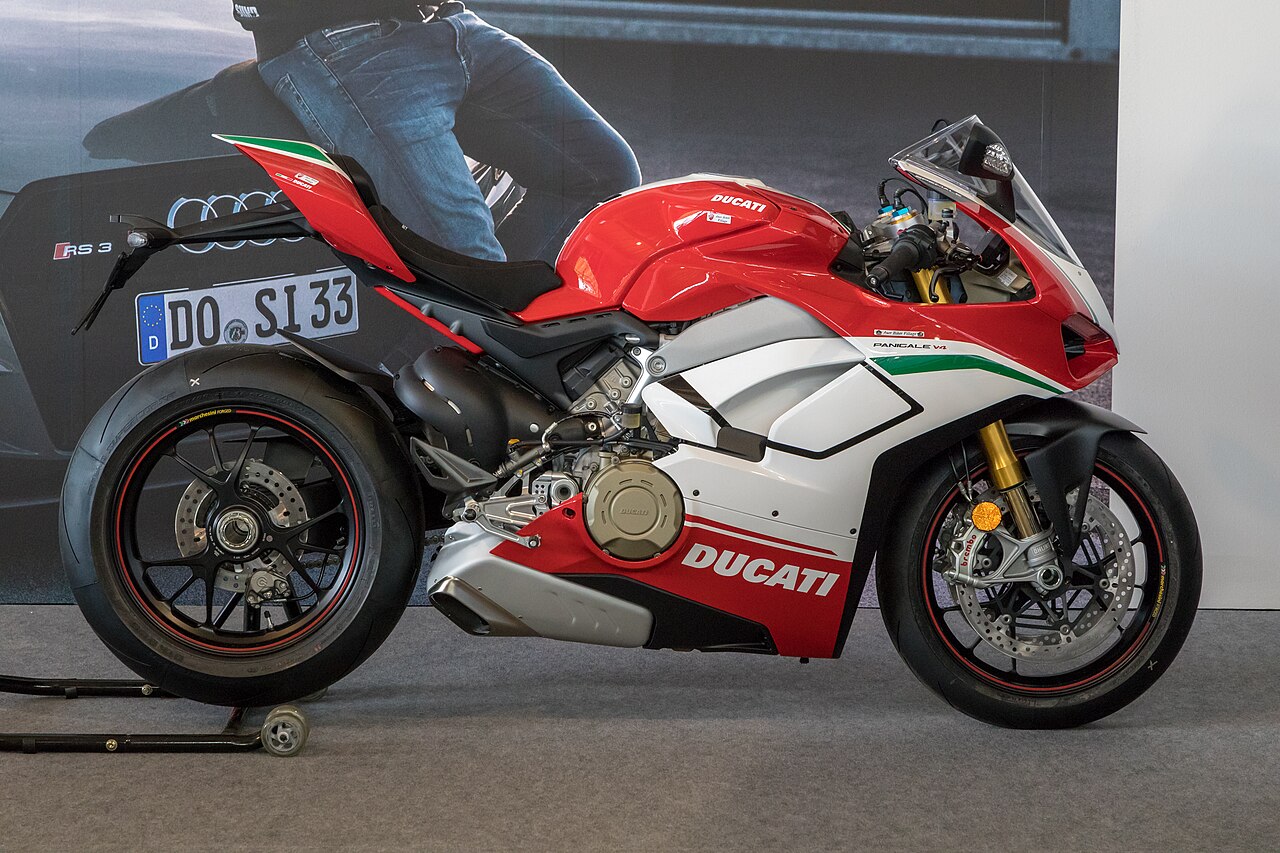
Ducati is the marque most associated with the aero era, and rightly so. Its engineers pushed winglets aggressively when rivals were still sceptical, endured the ridicule, and were vindicated as the lap times and their imitators piled up. The knowledge fed directly into the road-going Panigale V4, whose integrated aerodynamic fairings are not decorative flourishes but genuine downforce generators derived from the Desmosedici Grand Prix programme. On a bike making well over two hundred horsepower, that downforce helps keep the front planted under savage acceleration and improves stability at the enormous speeds the V4 is capable of reaching, giving a skilled rider a more usable, less intimidating machine at the limit. Rivals who once dismissed the fins have long since fitted their own, and the aerodynamic arms race Ducati started shows no sign of cooling on track or in the showroom.
What Winglets Cost You
Aerodynamic downforce is never free, and the engineering is a constant negotiation of trade-offs. Anything that presses the bike down also adds drag, blunting top speed and costing fuel, so every wing is a compromise between stability and slipperiness. Winglets add weight in the worst possible place, high and forward, and they change how the bike responds to side winds and to the turbulent air behind a rival machine, which affects overtaking. They also complicate crashes and raise safety questions, which is why governing bodies now regulate aerodynamic development tightly. Getting the balance right is precisely where the cleverest teams find their advantage, extracting downforce while paying the smallest possible penalty elsewhere. There is also the rider to consider, because heavy downforce changes how the bike steers and how it behaves in the dirty, turbulent air behind a rival machine, subtly reshaping the tactics of an entire race.
- Winglets press the front wheel down, taming wheelies under hard acceleration
- That lets the rider deploy power earlier with less electronic intervention
- They add front-end stability into fast corners and under heavy braking
- The cost is extra drag, added weight up high, and trickier turbulent air
- Regulators now police aero closely on grounds of cost and safety
Ground Effect and the Belly
The frontier has moved on from simple fins to the whole shape of the machine. Engineers increasingly work the underside and the belly of the fairing, chasing so-called ground effect and managing how air flows beneath and around the bike, not just over a pair of wings. Rear-end aerodynamic devices and carefully sculpted tail sections now play their part too, and the visible winglets are only the most obvious tip of a much larger aerodynamic effort. This is why modern race bikes look so busy and complex compared with the clean fairings of twenty years ago: almost every surface is now doing aerodynamic work rather than merely covering the mechanicals. Expect the trend to continue, with future machines devoting ever more of their bodywork to managing airflow, and expect the road bikes to inherit those hard-won lessons a season or two later.
Three years ago, adaptive cruise control on a motorcycle was an exotic curiosity, restricted to a handful of premium tourers and treated with deep suspicion by traditionalists. Today it is spreading through the market at a pace that has surprised even the engineers who built it. Front and rear radar modules, once the preserve of six-figure machines, now appear on bikes you might reasonably commute on. The technology has crossed the line from novelty to expectation, and understanding why tells you a great deal about where riding is headed over the next decade.
The short version is that the hardware got cheap and the software got good. Automotive radar development, funded by billions of dollars of car-industry investment, produced sensors small and affordable enough to bolt onto a headstock. Motorcycle engineers adapted them, refined the algorithms for a leaning vehicle, and the result is a system that now costs manufacturers a fraction of what it did at launch. Once a component becomes that cheap, its spread across a range is only a matter of time.
What the Radar Actually Does
At its simplest, forward radar lets the bike hold a set distance from the vehicle ahead, easing off and accelerating automatically as traffic ebbs and flows. On a long motorway slog this transforms the experience, removing the constant throttle micro-adjustments that quietly exhaust a rider over hundreds of miles. But the same sensor enables far more: forward collision warning, blind-spot monitoring from a rear unit, and lane-change alerts that flash when something lurks in your mirrors. On the BMW R1300GS the system is polished enough to feel invisible until you need it, which is exactly the point of a well-designed rider aid.
Why It Spread So Fast
Cost was the trigger, but demographics pulled it through. The average buyer of a large-capacity bike is older and more affluent than a decade ago, has likely experienced adaptive cruise in a car, and expects the same convenience on two wheels. Manufacturers noticed. Fitting radar also lets a brand charge a premium and, crucially, differentiate a flagship in a crowded market. When KTM added it to the 1390 Super Duke R, a bike whose entire identity is aggression, it was a clear signal that radar is no longer just a touring accessory but a mark of a serious modern motorcycle, as expected on a flagship as a colour dashboard or a quickshifter.
The motorcycle industry loves to talk about power. Peak horsepower, top speed and lap times fill the brochures, because they are easy to measure and easy to sell. Yet the most consequential engineering of the past decade has happened almost silently, in software you never see and sensors you never think about. This is the quiet revolution in rider safety, and it is saving lives at a rate that finally shows up clearly in the accident statistics that regulators and insurers pore over every year.
None of it is glamorous. There is no marketing romance in a lean-angle sensor or a brake-pressure algorithm, and no showroom customer ever fell in love with an inertial measurement unit. But the cumulative effect of these systems is that riders now survive mistakes that would have put them in hospital, or worse, a generation ago. Here is what is actually doing the work, and why it matters more than any dyno chart on the wall.
Cornering ABS Changed Everything
The single biggest advance is the six-axis inertial measurement unit, a coin-sized cluster of gyroscopes and accelerometers that knows the bike’s precise attitude hundreds of times a second. It made cornering ABS possible — braking hard mid-corner without the front tucking and throwing you to the ground. On a machine as ferocious as the BMW M1000RR, the same IMU governs traction, wheelie and slide control, orchestrating a symphony of interventions no human could manage. But the version that saves ordinary riders is the humble cornering ABS now filtering down to modest commuters. It intervenes in the exact scenario that kills so many: a panic grab of the brakes while leant over into an unexpected hazard on a road you thought you knew.
Traction Control for the Rest of Us
Traction control was once a superbike toy, dismissed as a crutch for the ham-fisted. That snobbery has aged badly. Modern systems are so refined that most riders never feel them working, yet they catch the wet manhole cover, the diesel spill and the greasy roundabout that would otherwise spit a bike sideways. Lean-sensitive versions modulate power according to how far the bike is banked over, delivering full drive upright and gentle restraint at the edge of grip. It is the difference between a heart-stopping moment and a story you never even bother to tell, and it works quietly in the background on bikes costing a fraction of a superbike.