Every generation gets one adventure-bike argument that actually matters, and right now it’s this one. Forget the six-figure boxer-twin flagships with their radar cruise control and semi-active suspension — the real battleground for genuine, everyday adventure riding is happening at the affordable end of the class, and it comes down to two bikes: the Royal Enfield Himalayan 450 and the KTM 390 Adventure. Both are small-capacity, single-cylinder machines built to be thrashed on gravel, ridden to work on Monday, and loaded up for a three-week trip in October. Only one of them is right for you.
I’ve spent real miles on both — pavement, fire roads, and the kind of rutted, rock-strewn trail that makes you question your line choice and your life choices simultaneously. What struck me is how differently these two machines interpret the same brief. The Himalayan 450 is built by a company that has spent decades sending riders across actual Himalayan passes and racing works bikes through rally-raid gravel. The 390 Adventure is built by a company that has spent decades winning Dakar outright with bigger bikes, then applying its sharpest road-going engineering to a small ADV that would rather carve a canyon than crawl a riverbed. Same category, wildly different soul.
Two singles, two very different personalities
Royal Enfield’s Sherpa 450 is a 452cc, liquid-cooled single that makes a claimed 40 hp at 8,000 rpm and roughly 40 Nm of torque lower in the rev range. On paper it sounds unremarkable next to the KTM. In practice it’s a deliberately relaxed, long-legged engine tuned for tractability over drama — the kind of motor that lets you feed in throttle over loose rock without the rear end stepping out unexpectedly. It doesn’t rev with any enthusiasm past seven grand, and it doesn’t need to.
KTM’s LC4c — the 399cc single that also powers the 390 Duke — is a punchier, more highly strung unit, claiming around 45 hp at 8,500 rpm with slightly less outright torque than the Sherpa but delivered with far more urgency. It likes to be worked. Roll it on hard out of a corner and it responds with a keenness the Himalayan simply doesn’t have, and that single extra gear’s worth of eagerness defines almost everything else about how these two bikes feel on the road. The KTM feels like a sportbike engine wearing hiking boots; the Royal Enfield feels like a diesel generator that happens to be genuinely likeable.
Off the beaten path: who's the real adventurer
This is where the Himalayan 450 earns its name. Long-travel Showa suspension, a proper 21-inch front wheel, and a chassis tuned first for the dirt and second for the tarmac make it feel unflappable once the road turns to washboard or worse. Royal Enfield’s rally programme — which genuinely campaigns Himalayan-based machines in rough-country events — isn’t just a marketing footnote; it shows up in how forgiving this bike is when you get a line wrong. The low-end torque delivery does the hard work for you on loose surfaces, and the whole package feels like it was engineered by people who actually expect you to drop it.
Adventure motorcycling has quietly become an expensive habit, with flagship machines now costing as much as a small car and weighing nearly as much too. The Himalayan 450 is Royal Enfield’s cheerful rebuttal. Here is a genuinely capable adventure bike, built to tackle the world’s roughest roads, that costs less than the accessory catalogue of some of its rivals — and it is all the more likeable for it.
This is not the crude, underpowered Himalayan of old, either. The 450 is a comprehensive reinvention, built around an all-new engine and chassis, and it transforms the bike from a charming budget curio into a serious, modern proposition. For new adventurers and hard-up dreamers alike, it changes the conversation entirely.
The Sherpa engine: modest but eager
The new liquid-cooled 452 cc single, named Sherpa, is the making of this bike. Producing a genuine 40 hp and 40 Nm, it is willing, flexible and far more refined than the old air-cooled lump it replaces. It pulls cleanly from low revs — ideal for picking a line up a rocky climb — and revs out with real enthusiasm when you want to make progress on a flowing back road.
This is not a fast motorcycle in outright terms, cracking 100 km/h in a leisurely 6.9 seconds and topping out around 150 km/h. There is some vibration high in the rev range, and sustained motorway cruising is not its forte. But for the winding, unhurried, exploratory riding this bike was built for, the Sherpa has exactly the right character and just enough power.
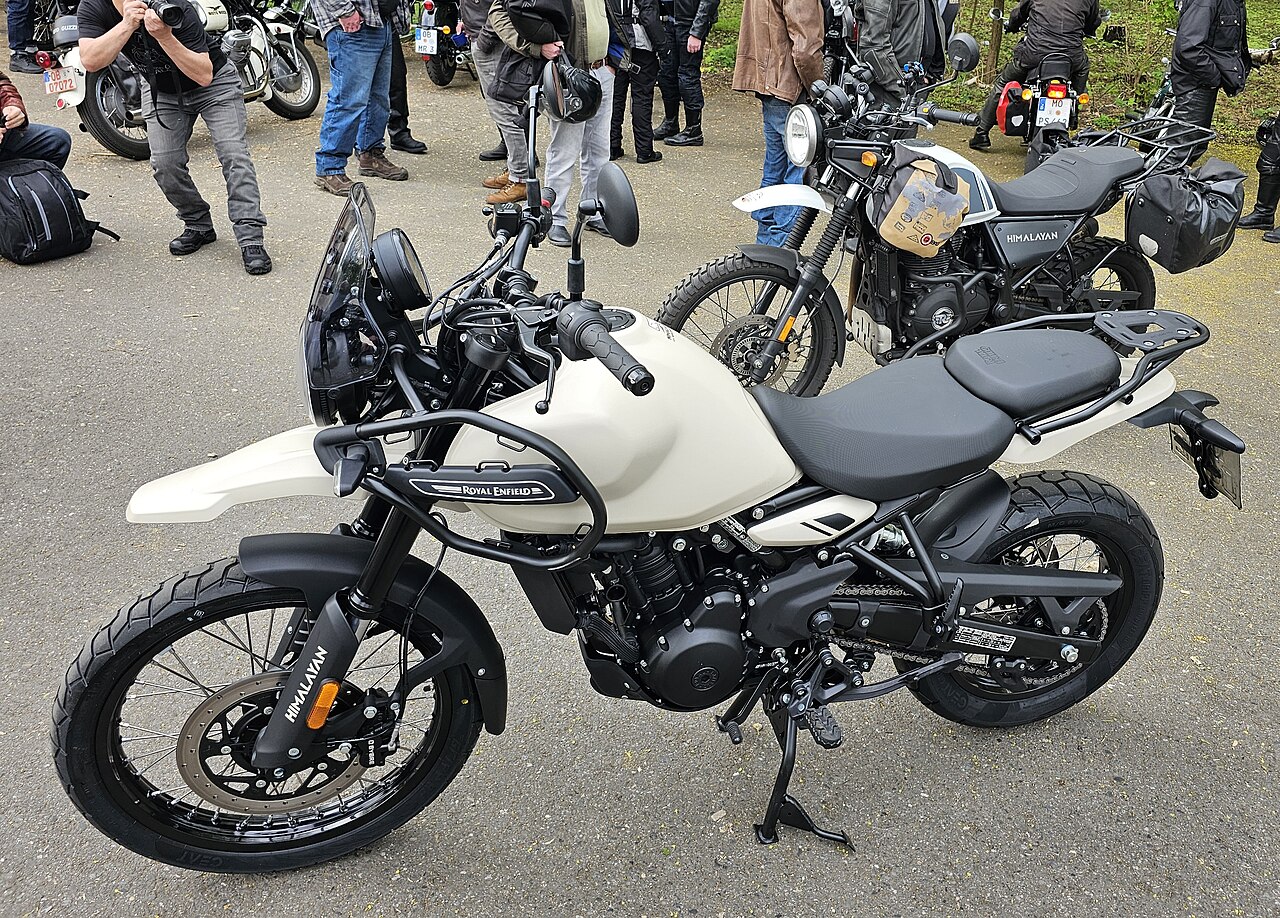
On paper this looks like a mismatch — a modestly powered single-cylinder budget bike against a sophisticated middleweight triple costing more than twice as much. But adventure riding has always been about far more than horsepower, and the Royal Enfield Himalayan 450 has arrived with genuine ability and a price that forces every rider to ask a hard, honest question: how much motorcycle do I actually need?
The Triumph Tiger 900 is the accomplished, do-everything adventurer that has earned its reputation over many years. The Himalayan 450 is the plucky underdog that has grown up dramatically with its new liquid-cooled engine. This comparison is less about which is objectively better and more about where your money and your ambitions truly meet on the map.
Engine and performance
The Himalayan’s new 452cc liquid-cooled Sherpa single produces around 40 hp and 40 Nm — modest figures on paper, but delivered with a friendly, tractable spread that suits gentle trails and unhurried touring perfectly. It will happily cruise at highway speeds, though it runs out of puff for rapid overtakes and heavily loaded climbs. The Tiger 900’s 888cc triple, with roughly 108 hp and 90 Nm, lives in an entirely different dimension: effortlessly fast, richly torquey and blessed with a wonderful off-beat exhaust note.
If your riding involves long motorway stints, heavy luggage or a passenger, the Tiger’s power is genuinely transformative and makes light of any road. If your world is back roads, gravel and the occasional highway blast, the Himalayan has just enough grunt, and its gentler pace encourages a slower, more contemplative and arguably more rewarding kind of adventure altogether.
Chassis and off-road
Both bikes come genuinely equipped for the dirt, which is where the Himalayan surprises most. It rides on a 21-inch front wheel with long-travel Showa suspension and a manageable, low-slung feel that flatters less experienced off-road riders. At around 196 kg it is only slightly heavier than the Tiger, but its gentler power delivery makes it feel far more benign when the going gets loose and technical. The Tiger, especially in Rally trim, offers more suspension quality and outright capability, but demands more skill to exploit safely.