Grand Prix racing has always justified its eye-watering budgets with a single promise: the technology forged under the fiercest competition on earth eventually filters down to the machines ordinary riders can buy. For decades that trickle-down was mostly about engines and frames. Today it is overwhelmingly about electronics and aerodynamics — the invisible systems that let a modern superbike deploy more than two hundred horsepower without spitting its rider into the scenery. Sit on a current Ducati Panigale V4 or a BMW M 1000 RR and you are, in a very real sense, borrowing hardware and thinking that was science fiction in the MotoGP paddock barely fifteen years ago.
The remarkable part is how completely this has happened, and how little the average buyer notices. The magic hides behind the menus. Here is what actually made the journey from the prototype grid to your driveway.
The Six-Axis Brain
The single most important piece of trickle-down technology is the inertial measurement unit, or IMU. This matchbox-sized cluster of accelerometers and gyroscopes tracks the motorcycle’s movement through space — lean angle, pitch, roll, yaw and acceleration — hundreds of times a second, and hands that live picture to the bike’s electronic brain. Once the machine knows precisely how far it is leaned over and what it is doing, every other rider aid becomes vastly smarter. MotoGP and its factory engineers drove the miniaturisation and refinement of these sensors, and by the middle of the last decade the six-axis IMU had reached flagship road bikes. It is the foundation stone; without it, cornering traction control and lean-sensitive ABS would be impossible. What once required a rack of laboratory equipment now fits neatly under the seat and costs a fraction of what the first racing units did, which is precisely why the technology was able to spread so far so quickly.
Winglets Come Down to Earth
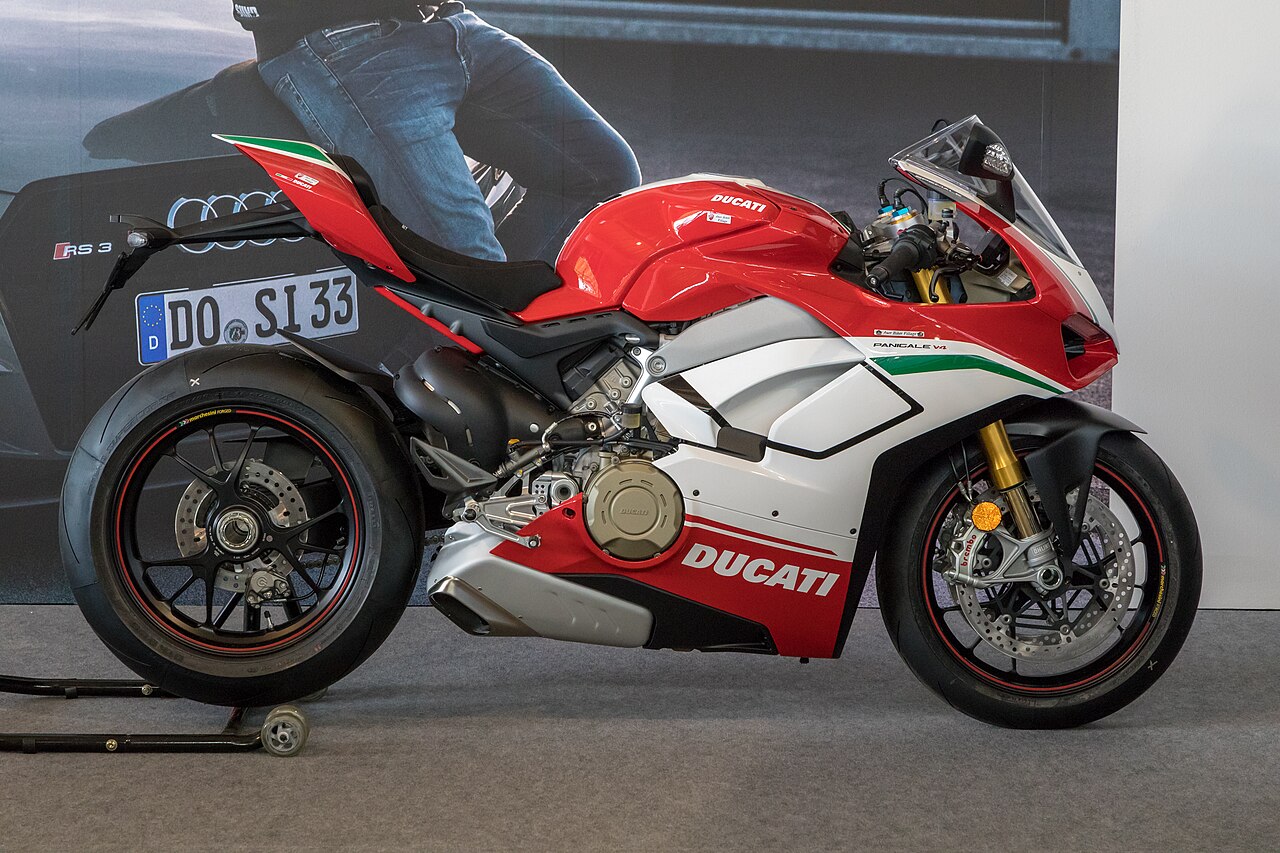
The most visible import from the paddock is aerodynamic downforce. When Ducati provocatively bolted winglets to its Desmosedici racer, the paddock scoffed, then scrambled to copy the idea once the lap times spoke. Those carbon appendages press the front wheel into the tarmac at speed, taming the tendency to wheelie under brutal acceleration and improving stability into fast corners. Within a few short seasons the wings migrated straight onto road-going flagships. The Panigale V4 wears integrated aero fairings drawn directly from Ducati’s Grand Prix programme, and the BMW M 1000 RR carries its own M winglets — genuine functional downforce on a bike you can ride to breakfast, not merely styling theatre. The effect is subtle at legal speeds and pronounced at the pace these machines were truly built for, keeping the nose planted where an unaided litre-bike would paw at the air.
A modern superbike does not make you a better rider. It makes your mistakes survivable — and that safety net was woven, thread by thread, on the MotoGP grid.— Sam Whitlock, Racing Editor
Launch Control and the Quickshifter
Two paddock staples have become so common that riders now expect them as standard. The up-and-down quickshifter, which lets you bang through the gearbox flat-out without the clutch or throttle, began as a way to shave hundredths from a racing lap and is now fitted to bikes far down the price ladder. Launch control, which manages engine speed and wheelspin off the line for a clean, repeatable getaway, made the identical journey. On a Panigale V4 or an M 1000 RR both operate with a precision that would have shamed a factory race team a couple of decades ago, and they turn a tricky standing start into something a competent road rider can execute cleanly and consistently. A generation ago, launching a superbike hard demanded a delicate, practised clutch hand; today the electronics do the fine work, and the rider simply holds the throttle open and trusts the software to sort out the rest.
Cornering ABS and the Safety Net
Perhaps the most genuinely life-saving trickle-down is lean-sensitive, or cornering, ABS. Traditional anti-lock braking only worked reliably with the bike upright; grab a fistful of brake mid-corner and older systems could still tuck the front and pitch you off. By feeding IMU lean data into the braking algorithm, engineers created systems that modulate braking force according to how far the bike is banked over, allowing a rider to scrub off speed mid-bend without losing the front. The same IMU foundation enables slide control, engine-braking management and wheelie control, each quietly intervening thousands of times a ride. The rider feels a benign, confidence-building machine; underneath, a Grand Prix-grade computer is working furiously to keep the rubber planted. The rider rarely notices these systems working at all, which is exactly the point: the very best electronic aids are the ones that feel like natural talent rather than intrusive technology.
- Six-axis IMU: the sensor cluster that tells the bike its exact attitude in real time
- Cornering traction control and lean-sensitive ABS built on that IMU data
- Up-and-down quickshifters and launch control lifted straight from race procedure
- Aerodynamic winglets generating real front-end downforce on road flagships
- Slide, wheelie and engine-brake control smoothing the delivery of huge power
What Is Still Locked in the Paddock
Not everything has escaped the garage, and the gap is a useful reminder of just how extreme prototype racing remains. The seamless-shift gearbox, which changes ratio with no interruption of drive at all, stays largely a racing exotic on cost and complexity grounds. Sophisticated ride-height devices, which physically squat the bike for launches and top-speed runs, have been progressively restricted even within MotoGP itself and remain absent from showrooms. And the pneumatic-valve engines spinning to astronomical revolutions in the premier class are a world away from anything homologated for the road. The frontier keeps moving; today’s paddock secret is tomorrow’s brochure bullet point. History suggests it is only a matter of time and cost before some of today’s paddock exotica trickles down to the showroom as well, just as the once-radical IMU eventually did.
To the casual eye they look almost identical: brightly liveried motorcycles, leather-clad riders dragging elbows through corners at improbable lean angles, factory teams spending fortunes to win. Yet MotoGP and the Superbike World Championship are fundamentally different sports, built on opposite philosophies, and understanding that difference is the key to enjoying both. One is a contest of pure, unconstrained engineering ambition; the other is a contest of the fastest versions of bikes you could, in principle, ride to the shops. That single distinction ripples out into the machines, the rules, the costs and the very texture of the racing.
So let us settle the pub argument properly, because the honest answer is more interesting than the usual lazy shorthand of faster versus slower. The two series share a grid full of talent and a shared passion for two wheels, yet almost nothing about how they arrive at a Sunday result is genuinely the same.
Prototypes Versus Production
The defining difference is homologation. A MotoGP bike is a pure prototype: a one-off racing machine designed from a blank sheet, of which not a single roadgoing copy exists or ever will. You cannot buy a Desmosedici GP; you can only watch it. WorldSBK is the opposite. Every bike on that grid must be derived from a production motorcycle that ordinary customers can walk into a dealership and buy, then modified within strict limits for competition. A Kawasaki Ninja ZX-10R racing in WorldSBK shares its fundamental architecture with the ZX-10R in the showroom. That is the whole point of the series — it is the ultimate proving ground for machines you can actually own. That link is not a marketing slogan but a hard rule enforced by minimum production numbers, ensuring the racer and the road bike remain genuine relatives rather than distant acquaintances.
The Machines
That philosophical split produces very different weapons. MotoGP prototypes run roughly a litre of screaming, pneumatic-valve engine producing power figures north of anything a road bike can dream of, wrapped in exotic carbon and magnesium, riding on bespoke Michelin slicks, and stuffed with technology invented purely to win. WorldSBK machines start from production litre-bikes, make very serious power but noticeably less than the prototypes, and race on a control Pirelli tyre that every team must use. The prototype is a scalpel forged without compromise; the superbike is a road bike stripped, sharpened and unleashed. Both are ferociously fast, but only one has a distant cousin parked in a suburban garage. The prototype answers to no accountant and no customer; the superbike must begin life as something a factory can build in numbers and sell at a profit, and that single constraint is felt in every component.