Kawasaki doesn’t do sport-tourers by half measures, and the 2026 Ninja 1000SX proves it again without reinventing anything that didn’t need reinventing. This is a bike built for riders who want three hundred road miles in a day and a genuine sense of speed once the motorway ends, and for 2026 Kawasaki has sharpened exactly the parts of the package that mattered instead of chasing a redesign for its own sake.
That’s the headline, really: this isn’t a ground-up rethink. It’s a mature, fast, comfortable machine getting the electronics and finishing touches that keep it relevant against a field of rivals that have all gotten more expensive, more complicated, and in some cases more compromised. The 1043cc inline-four is still doing the heavy lifting, and it’s still one of the most satisfying engines in the class.
What's Actually New for 2026
The changes for 2026 are evolutionary rather than revolutionary, and that’s the right call for a bike that was already close to sorted. Kawasaki has refined the electronics suite — the IMU-based platform still underpins cornering ABS and traction control, but the calibration feels smoother at the margins, less like a system stepping in and more like it was never needed in the first place. The quickshifter remains standard fitment, and it’s still one of the slicker units in the class in both directions.
The TFT dash and Kawasaki’s Rideology smartphone connectivity carry over largely unchanged, which is fine — they already worked well enough. Where you’ll actually notice a difference is in small aerodynamic tweaks around the screen and fairing, aimed at cutting the buffeting that annoyed taller riders on earlier versions, plus a fresh set of colourways that lean into the SX’s sporting identity rather than pretending it’s an adventure bike in a two-piece suit.
None of this is flashy news. There’s no new engine, no radical chassis rework, no semi-active suspension arriving to justify a price hike. That restraint is arguably the smartest thing about the 2026 update: Kawasaki knows exactly what this bike is for, and it hasn’t tried to turn it into something else.
Sport-Tourer, Not Adventure-Tourer, Not Full Dresser
The sport-touring middle ground has gotten crowded and confused. Adventure-styled machines like Kawasaki’s own Versys 1000 borrow the same engine and try to do everything at once, while bikes like the BMW R1250RT lean fully into touring comfort at the cost of any real sporting intent. The Ninja 1000SX sits deliberately in between, and that positioning is the entire point of the bike.
It doesn’t have the wind protection of a full tourer, and it doesn’t want it. What it offers instead is a proper sportbike riding position softened just enough for a long day, a fairing that actually manages air rather than just looking sporty, and a chassis that will happily follow something far more exotic through a set of corners it has no business keeping up with. Set it against something like the Ducati Multistrada V4 and the difference in character — and in price — is stark.
This is also not a bike for riders chasing outright drama. If you want a hyper-sport experience, look elsewhere. The 1000SX’s whole appeal is that it’s quick without being intimidating, comfortable without being soft, and capable of covering serious distance without ever feeling like you’re piloting something the size of a Honda Gold Wing.
On the Road: The Bit That Actually Matters
Numbers on a spec sheet don’t tell you what a bike feels like at 7,000rpm with a full tank and 200 miles still to go, and that’s where the 1000SX earns its reputation. The inline-four pulls hard and cleanly from low in the revs, with none of the flat spots that plague some torque-focused sport-tourers, and it still has enough top-end urgency to make an overtake feel genuinely satisfying rather than merely adequate.
The riding position rewards a long stint better than most bikes wearing this much fairing plastic. Wrists carry a fair chunk of weight at low speed, as you’d expect from something with sporting DNA, but that weight disappears once you’re moving and the aero is doing its job. The seat is the one component that starts reminding you of the miles after a few hours — it’s fine, not outstanding, and riders planning genuinely long tours would be sensible to budget for an aftermarket perch.
Modern-classic bikes are a wonderful lie. They dress up thoroughly contemporary engineering — fuel injection, ride-by-wire throttles, ABS, traction control — in bodywork borrowed from an era when none of that existed. Nobody tells this lie better than the Kawasaki Z900RS and the Triumph Speed Twin 1200, two bikes that spend all day pretending to be forty years old while quietly being some of the most competent naked machines currently on sale.
I put real miles on both, back to back, on the same loop of fast dual-carriageway and tight, cambered B-roads. What emerged was not a knockout, but two entirely different arguments for what a retro roadster should feel like under your hands. One is a smooth, howling inline-four wrapped around a Z1 silhouette. The other is a gorgeously finished parallel-twin that trades outright pace for a tactile richness the Kawasaki simply cannot fake.
Engine character: the four versus the twin
The Z900RS runs Kawasaki’s 948cc inline-four, retuned from the standard Z900’s version for a fatter midrange, and it is a genuinely lovely engine. Power lands around 109 hp at 8,500 rpm, with 98.5 Nm arriving at 6,500 rpm, and the delivery is silky from idle to redline. There is a building, mechanical howl as the tacho sweeps past 7,000 rpm that no twin can replicate — this is the sound the whole bike is built around, and it does not disappoint.
Triumph’s Speed Twin 1200 counters with its 270-degree, 1,200cc parallel-twin, good for roughly 103 hp at 7,750 rpm and a meatier 112 Nm arriving much lower down, around 4,250 rpm. On paper it trails the Kawasaki at the top of the rev range. On the road it rarely matters, because the Triumph is already shoving you toward the next corner while the Z900RS is still building revs. This is a torque-first engine, and it feels like one from the first twist of the wrist.
Neither engine is objectively “better” — they are simply chasing different feelings. The Kawasaki rewards a rider who likes to work through the gears and chase a note; the Triumph rewards one who wants to feel a punch in the chest at 3,000 rpm and not think about the gearbox again until the next roundabout. If you have ever argued about whether a V8 or a straight-six sounds better, you already know which side of this you land on.
Handling and how each one carries speed
Weight tells an important part of this story. The Z900RS is a genuinely heavy retro bike at around 215 kg kerb, and you feel every one of those kilograms at low speed and in tight, technical turns — it wants a firm hand to change direction quickly. The Speed Twin 1200 is only marginally lighter on the spec sheet at roughly 216 kg, yet it feels noticeably more agile in the real world, largely down to how that mass is carried low and central around the twin’s compact crankcase.
Through faster, sweeping corners the Kawasaki settles into a reassuring, planted stance and its non-adjustable-at-the-front-but-still-composed suspension soaks up mid-corner bumps without drama. The Triumph’s fully adjustable Marzocchi fork and Öhlins-style rear shock (on higher trims) give it a noticeably more premium ride quality — more feel at the bars, better control over broken surfaces, and a chassis that flatters a rider trying to carry speed rather than merely permitting it.
Neither bike is a sportbike wearing a disguise, and neither pretends to be. But if you spend your weekends hunting apexes on a favourite road, the Speed Twin’s superior damping and sharper front-end feedback will have you grinning earlier and more often. The Z900RS is happy to follow along at a slightly more relaxed pace, and honestly, most owners of either bike will never find the limit of what’s on offer here.
Build quality and finish
This is where the gap between these two widens most dramatically, and it is the single biggest reason the Triumph costs what it costs. Run your hand over the Speed Twin’s tank, its brushed engine covers, the machined fins on the cylinder head, the twin analogue clocks — everything feels like it was finished by someone who cared. Paint depth, switchgear weighting, the satisfying click of the indicator stalk: this is a bike built to be looked at as much as ridden, and it rewards close inspection in a way few naked bikes at any price manage.
The Z900RS is not shoddy — far from it — and its teardrop tank and round headlight nail the Z1 silhouette with real conviction. But get up close and the Kawasaki’s switchgear, some of its plastics and its slightly generic instrument cluster reveal a bike built to a tighter cost target. It looks the part from ten feet away, which is exactly where most onlookers will admire it, but the Triumph looks the part from ten inches away too, and that difference is exactly what premium pricing is supposed to buy.
Price and everyday value
Here the Kawasaki claws back real ground. The Z900RS starts at roughly $12,649, undercutting the Speed Twin 1200 by a meaningful margin — Triumph’s twin typically lands closer to the $13,500 mark once you factor in the higher-specification variants most buyers actually want. For that saving you get a faster-revving, more powerful engine on paper and a badge with its own considerable heritage cachet in most markets.
Running costs favour the Kawasaki too, at least on paper: four-cylinder engines are famously long-lived, parts availability is broad, and service intervals are undemanding. The Triumph’s premium components — that adjustable suspension in particular — cost a little more to maintain over a long ownership, though nothing about the Speed Twin is remotely exotic or fragile. Think of the price gap less as “cheap versus expensive” and more as “good versus better,” because that is really what you are paying for.
The A2 licence used to mean compromise. Buy something small, sensible and a little bit sad, then count down the days until your restriction lifted and you could finally have a proper motorcycle. The Kawasaki Ninja 500 and Aprilia RS 457 are the loudest proof yet that those days are over. Both are full-fairing, parallel-twin sportsbikes built from the ground up for restricted licences, and both are genuinely good motorcycles rather than watered-down ones.
We spent real time on both, back to back, on the same roads and at the same pace, and the gap between them turned out to be far more interesting than a simple spec-sheet swap. One is the safe, sensible evolution of a bike that has taught a generation of riders how to use a clutch. The other is a proper Italian sportsbike shrunk down to size, engineered in-house rather than bought off a shelf. Neither is the wrong answer. But they are answers to slightly different questions.
Engine character
Kawasaki’s 451cc parallel-twin is the bigger-bore evolution of the engine that powered the outgoing Ninja 400, and it shows in the best way. Power arrives smoothly and predictably from low revs, with none of the nervous snatchiness that can catch out a genuine beginner, and the extra displacement over its predecessor fills in exactly the mid-range hole that used to force constant gear-changing. It is not an exciting engine in isolation, but it is an honest one, and honesty matters enormously to someone still learning where the friction point on a clutch lever actually is.
Aprilia took a different, riskier route. Rather than adapting an existing unit, it engineered the 457cc twin in-house, with an uneven crank-pin offset that gives the engine a slightly lumpier, more characterful pulse than you would expect from something this small. Peak output lands right at the 35kW A2 ceiling by design, which means Aprilia never needed a restrictor kit to keep it legal, a detail Kawasaki’s more powerful twin cannot claim in every market. On the road the RS 457 feels the eager one of the two, keener to be revved, with a top end that genuinely rewards you for reaching for it.
Chassis and handling
This is where the badge on the tank starts to matter. The Ninja 500 wraps its twin in a conventional steel frame tuned for stability and predictability above all else, and it works. The bike is forgiving over broken tarmac, unbothered by a nervous rider stabbing at the bars, and happy to be ridden slowly without complaint. It steers accurately enough for a Sunday blast but never asks you to commit hard to a line, which is exactly the point for a bike aimed at someone still building confidence.
The Aprilia bolts its engine into a proper trellis frame, the same basic philosophy that underpins its RSV4 and Tuono flagships, and the difference is obvious the first time you tip it into a corner. It turns in faster, holds a line with more precision, and feels genuinely eager rather than merely capable. That sharpness comes with a small cost in outright forgiveness. The RS 457 rewards a rider who commits to the line they picked, rather than one who is still figuring out where the line should go. It is the more thrilling chassis, and also the more demanding one.
In an era when middleweight nakeds increasingly lean on twins and triples to hit a price, Kawasaki has quietly kept faith with the inline-four — and the Z900 is all the better for it. Here is a machine that delivers the creamy, revvy character of a four-cylinder engine, dresses it in menacing Sugomi bodywork, and asks a price that undercuts almost everything with comparable performance.
The result is one of motorcycling’s great value propositions. The Z900 does not chase headlines with radar cruise or carbon wheels; it simply nails the fundamentals of a fast, smooth, good-looking street bike, then leaves change in your pocket. For a huge swathe of riders, that is exactly the right set of priorities.
The joy of an inline-four
The 948 cc four is the heart of the appeal. Producing 125 hp and 99 Nm, it serves up the smooth, linear delivery that only a four can, spinning freely and cleanly to a soundtrack that hardens into a proper metallic snarl near the top of the rev range. There is enough midrange to make it flexible in town and enough top-end fizz to reward a hard ride.
It is not the torque monster that a big twin is, so you work the gearbox a little more to keep it on the boil, but that is part of the charm — the Z900 encourages you to ride it, to chase revs and hunt gears. A 3.5-second sprint to 100 km/h and a 240 km/h top end confirm there is nothing sluggish about this bargain.
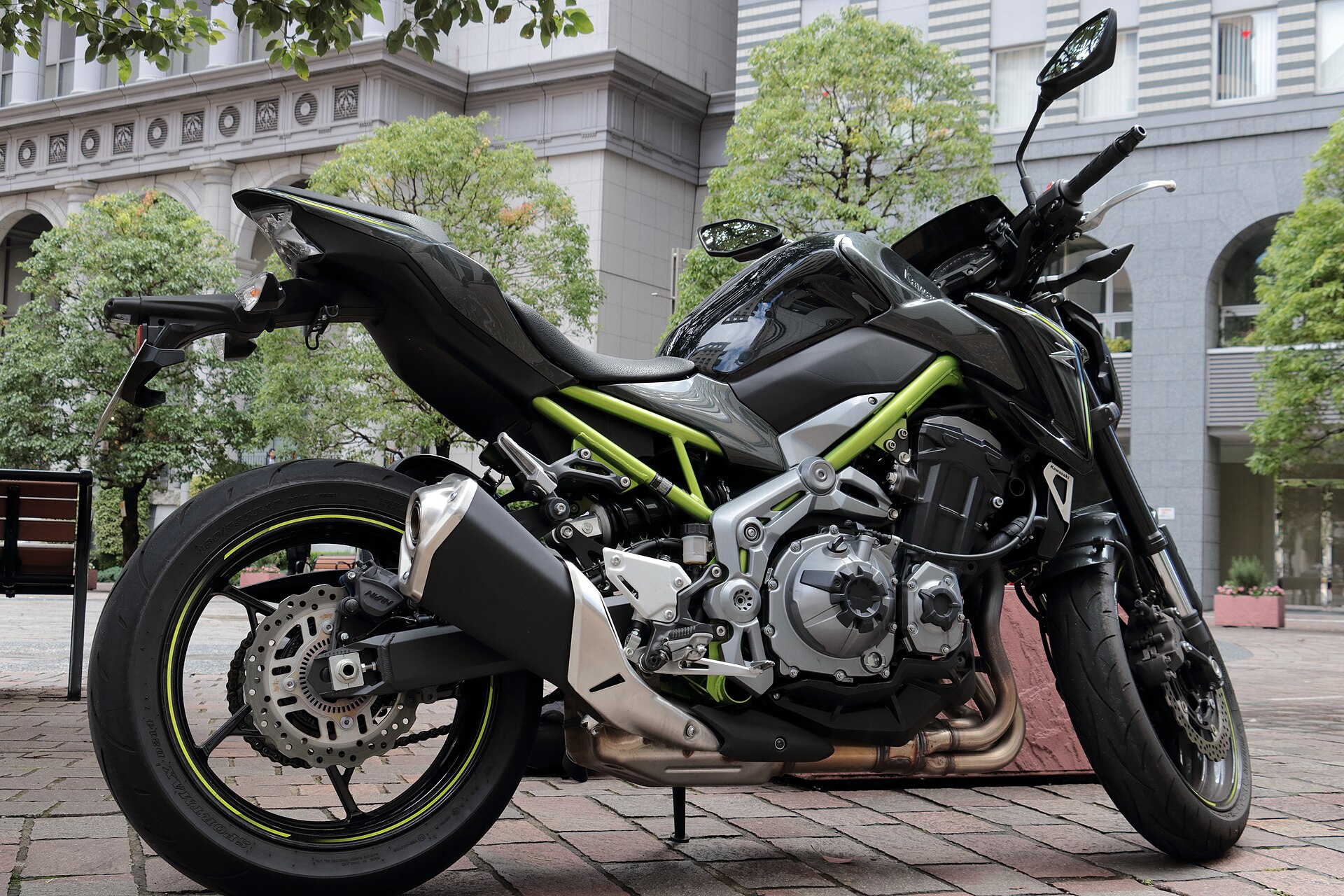
If the middleweight naked is the smart buyer’s sports bike, then the Kawasaki Z900 and Yamaha MT-09 are its two most popular graduates. Both hover around a hundred-and-twenty horsepower, both cost about the same as a modest hatchback, and both promise huge fun without the wrist-ache and insurance nightmares of a full superbike. Yet they go about it in wonderfully different ways, and choosing between them reveals a lot about the rider.
The Z900 is the smooth operator; the MT-09 is the wild child. It comes down to whether you prefer the silky sweep of an inline-four or the torque-drunk shove of a triple — a decision as much about temperament as performance.
Engine and delivery
Kawasaki’s 948cc inline-four is a paragon of refinement. Producing 125 hp and 98.6 Nm, it delivers its power in a long, linear, buttery surge that never feels intimidating and sings a classic four-cylinder note as the revs climb. It is the more sophisticated engine, happy to trickle through traffic or scream toward its redline with equal grace. The MT-09’s 890cc CP3 triple is the extrovert: 117 hp but a punchier, earlier hit of torque that lifts the front wheel and demands you hold on tight.
In the numbers game the Kawasaki has more peak power, but the Yamaha feels faster and more mischievous below 7,000 rpm, which is exactly where most road riding actually happens. The Z900 is the better engine for smoothness and gentle touring; the MT-09 is the better engine for grins, wheelies and general hooliganism. Both, refreshingly, are easy to live with day to day.
Chassis and weight
Weight is the MT-09’s ace. At around 193 kg it is noticeably lighter than the roughly 212 kg Z900, and you feel that 19-kilo gap in every direction change and every tight car park. The Yamaha flicks from side to side with playful ease, while the Kawasaki feels more substantial and planted — reassuring at speed but harder work through a series of tight switchbacks. Both use adjustable suspension that has improved markedly with each generation.