Long before electronics and aerodynamics dominated the conversation, superbike racing offered fans something Grand Prix racing could not: the thrilling sight of the very machines they could buy, or at least dream of buying, battling on the world stage. The Superbike World Championship, launched in 1988, was built on a simple, seductive premise — take production sportsbikes, modify them within tight limits, and let the manufacturers fight it out. From that idea grew one of motorcycling’s most colourful and passionately followed championships, a series defined by fierce rivalries, engine-configuration feuds and a run of champions who rewrote the record books.
Its history is really the history of the road bikes themselves, because every icon on the WorldSBK grid had a showroom twin. To trace the championship is to trace the evolution of the superbike as we know it.
Born in 1988
The championship arrived at the perfect moment. The 1980s had produced a wave of genuinely fast production sportsbikes, and fans hungered to see them raced against one another rather than watching untouchable Grand Prix prototypes. The new series gave manufacturers a global stage to prove their showroom machines, and it rewarded them with something priceless: bragging rights that translated directly into sales. Win on Sunday, sell on Monday was never truer than in early superbike racing, and the paddock quickly filled with factory efforts eager to demonstrate that their litre-bike, or their exotic twin, was the fastest thing a customer could ride home. The template was set, and it endures to this day. It also gave the sport a commercial logic no purely prototype series could match, because every victory doubled as an advertisement a customer could act on the very next weekend.
The Twin Versus Four Wars
The defining drama of the early championship was the feud between big V-twins and the inline-four screamers. Rules that balanced engine size against configuration allowed large-capacity twins to fight smaller-capacity fours, and Ducati seized the opportunity with both hands. The Bologna twins, and above all the legendary 916, became the bikes to beat, their booming character a stark contrast to the wailing Japanese fours. Carl Fogarty, riding those Ducatis with ferocious commitment, became the sport’s first great superstar and a multiple champion, turning the series into essential viewing. The twin-versus-four argument raged for years, and it gave superbike racing a narrative tension that pure single-configuration grids simply could not match. The rivalry had a tribal quality, twin loyalists and four devotees forever arguing the merits of character against outright revs, and it drew in fans who might otherwise never have followed racing at all.
Grand Prix gave us gods on machines we could never touch. Superbike gave us heroes on machines we could almost afford — and that made every win feel personal.— Sam Whitlock, Racing Editor
Japan Strikes Back
The Japanese manufacturers were never going to concede the stage for long. Honda answered with exotic, expensive homologation specials built expressly to win, and the other major marques poured resources into ever-sharper inline-fours. The balance of power swung back and forth across the seasons as rules were tweaked and machinery evolved, producing a genuinely multi-brand championship in which the identity of the dominant bike could change dramatically from one era to the next. This constant churn of competitiveness — the sense that no advantage was ever permanent — kept the racing fresh and the manufacturers honest, and it drove the relentless development that made each generation of road-going superbike sharper than the last. Each swing of the pendulum forced the losing camp back to the drawing board, and the road rider reaped the reward in showrooms full of ever more capable and affordable machines.
The Golden Era and the Records
The modern championship reached extraordinary heights of dominance and drama. Kawasaki, armed with the Ninja ZX-10R, entered a period of near-total supremacy, its rider stringing together a run of consecutive titles that redefined what sustained excellence looked like in the sport and set records many believed would never be approached. That dynasty eventually gave way to fresh challenges as Ducati’s V4 and other manufacturers clawed back competitiveness, and the balance tilted once more. The lesson of superbike history repeated itself yet again: dominance invites a response, the rules nudge the field back together, and the racing renews. It is a self-correcting spectacle, and that is precisely its enduring charm. No dynasty in the championship has ever proved permanent, and the certainty that today’s crushing advantage will be legislated and out-developed away is a large part of what keeps fans coming back season after season.
- 1988: the Superbike World Championship is founded on production-based machinery
- The 916-era Ducatis and Carl Fogarty turn twin-versus-four into box-office drama
- Japanese fours and homologation specials trade the advantage back and forth
- Kawasaki’s ZX-10R era rewrites the record books with a run of consecutive titles
- Ducati’s V4 and a new generation renew the fight in the modern championship
Homologation on Your Street
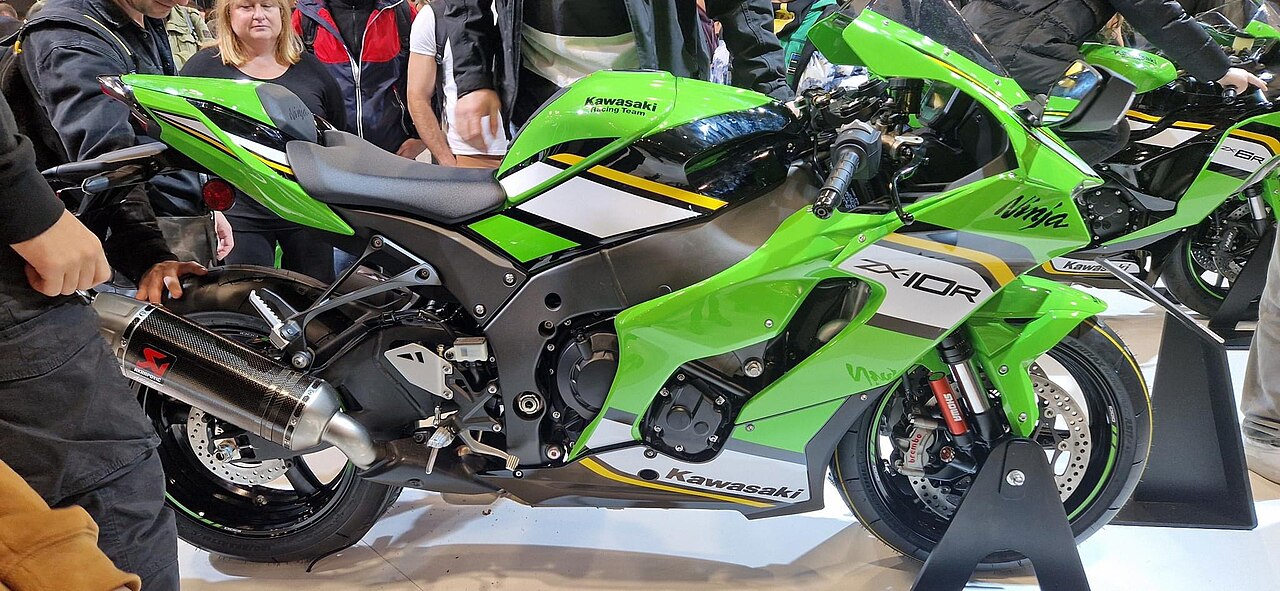
The most tangible legacy of superbike racing sits in showrooms, not trophy cabinets. The demand for competitive machinery pushed manufacturers to build homologation specials and road bikes bristling with race-bred technology, and those bikes are the direct ancestors of today’s litre-class weapons. A Kawasaki Ninja ZX-10R carries its WorldSBK pedigree openly, its chassis honed by racing success. A Yamaha YZF-R1, with its crossplane engine and MotoGP-derived electronics, embodies the same philosophy of the racetrack informing the road. Every time an enthusiast buys one of these machines, they are buying a piece of the championship’s competitive history, distilled and made street-legal for the daily rider. The engineering flows both ways, too, as lessons learned in the heat of competition feed directly into the next showroom model, keeping the road bikes evolving in lockstep with the racers they spawn.
There is nothing else in motorsport quite like the Isle of Man Tourist Trophy. While modern racing has retreated behind ever-taller gravel traps and air fences, the TT sends its competitors screaming down narrow public roads lined with stone walls, hedges, kerbs, houses and telegraph poles, at speeds that would be startling on a billiard-smooth Grand Prix circuit. It is glorious, it is anachronistic, and it is genuinely, statistically the most dangerous motorcycle race on the planet. To outsiders it can look like madness; to the riders and the island that hosts it, it is the purest and most honest test the sport has ever devised.
Understanding the TT means understanding a course, a history and a culture that together explain both the ferocious risk and the fierce devotion it inspires in equal measure.
37.73 Miles of Public Road
The event is run on the Snaefell Mountain Course, a daunting lap of roughly 37.73 miles of ordinary Manx roads closed for racing. It threads through villages and towns, over bridges, past pubs and front gardens, before climbing the mountain and plunging back down again, taking in around two hundred named corners along the way. There is no run-off worth the name; the margin for error is frequently measured in inches. Riders must commit lap after lap to a course so long and so complex that memorising every crest, kink and camber takes years of dedicated study. It is less a circuit than a landscape, ridden flat out and largely from memory. The scale is almost impossible to convey to anyone raised on stadium-tight modern circuits; a single lap is longer than many complete Grand Prix races, and every yard of it demands total, unbroken concentration.
A Century of the Mountain Course
The TT dates back to 1907, making it one of the oldest motorsport events in existence, and it has run in various forms for well over a century. For decades it even counted toward the motorcycle world championship, until the escalating dangers of racing on public roads led the Grand Prix circus to abandon it in the 1970s, with leading riders refusing to return. Rather than fade, the TT reinvented itself as a standalone festival of pure road racing, drawing specialists who thrive on exactly the kind of challenge that modern circuits have engineered out of existence. Its longevity is extraordinary, and its history is woven deep into the identity of the island itself.
On a short circuit a mistake costs you a place. At the TT a mistake can cost you everything — and every rider on that grid has made peace with the arithmetic.— Sam Whitlock, Racing Editor
Why It Is So Dangerous
The danger is not an accident of the TT; it is baked into its very nature. Racing at extreme speed on roads bounded by unforgiving solid objects means that many crashes which would be harmless on a modern track are catastrophic here. Weather on the mountain can change in minutes, the surface varies from section to section, and there is simply nowhere to run off. The event has claimed a grievous toll over its history, with the number of competitor fatalities running well into the hundreds since 1907, a fact the paddock neither hides nor forgets. Every rider who lines up does so with a clear-eyed understanding of the stakes, and that sober acceptance is part of what sets TT racers apart. There is no pretending otherwise, and the organisers, riders and island community have long since abandoned any comforting fiction that the risk can simply be engineered away as it has been elsewhere.
- Around 37.73 miles of closed public road per lap, with roughly two hundred corners
- Stone walls, kerbs, buildings and telegraph poles inches from the racing line
- No meaningful run-off, so ordinary mistakes can carry the gravest consequences
- Rapidly changing mountain weather and a surface that varies along the lap
- A course so long it must be learned and largely ridden from memory
The Riders Who Master It
The TT produces its own breed of legend, riders whose names mean little outside road racing but who are worshipped within it. The Dunlop dynasty stands above all: Joey Dunlop amassed a staggering tally of victories and became the event’s patron saint, while his nephew Michael has carried the family name to the top of the modern winners’ list. John McGuinness, another towering figure, spent decades among the fastest men on the mountain and became synonymous with the event. These are not weekend chancers but supreme specialists, blending raw courage with an almost supernatural memory for the course and a mechanical sympathy honed over countless laps of the most demanding road on earth. They speak of the course almost as a living thing, to be respected and read rather than conquered, and the humility that attitude demands is itself a kind of survival skill.
The 130 mph Barrier
For all its dangers, the TT is a relentless pursuit of speed, and the headline measure is the outright lap record. Riders long chased the symbolic milestone of averaging more than 130 miles per hour around the entire 37-mile lap — an almost incomprehensible figure given the obstacles involved — and the fastest men have pushed the record beyond 135 miles per hour in recent years. To average such a speed over a course through villages and up a mountain, a rider must be flat in top gear between houses and hedges for mile after mile. The bravery and precision this demands is difficult to overstate, and each new record is greeted with a mixture of awe and unease.