Everyone who has ever leaned over a used Ducati Scrambler in a dealer’s yard has felt the same tug. The trellis frame glows red under the paint, the tank is short and stubby in exactly the right way, and the whole bike promises a decade of easy, stylish riding for less money than almost anything else wearing an Italian badge. I have bought two of these things used, sold one at a loss I fully deserved, and watched enough friends get burned to say this plainly: the Scrambler is a genuinely brilliant used buy and a genuine minefield, often on the very same example.
That contradiction is the whole story. Ducati built the Scrambler to be a lifestyle object first and a motorcycle second, and it sold in numbers that flooded the used market with bikes bought by people who had never owned anything Italian before and had no idea what that actually meant, day to day. Some of those bikes were babied. Plenty were not. The trouble is they all look identical in a set of forecourt photos, and the difference between the good one and the money pit is buried in places a casual look-over will never find. Here is what actually goes wrong, what a fair price looks like, and exactly where to put your hands before you put down a deposit.
The Belt Job Nobody Budgets For
Start with the engine, because it is where the real money hides. The Scrambler’s desmodromic twin uses rubber timing belts to drive its camshafts, and Ducati has always specified that these get replaced on a calendar, not just a mileage counter. A belt that has done only a few thousand miles over several years still needs changing on schedule, because the rubber perishes with age and heat cycling whether or not the bike has actually been ridden anywhere. This is the single most common thing I see private sellers either not know about or quietly not mention, and it is not a cheap job to discover you need after the fact.
The maddening part is how invisible a missed belt service is from the saddle. The bike starts, idles and rides exactly the same right up until the day it does not, and a badly deteriorated belt on a desmodromic engine is not a gentle limp-home fault — it can put a valve where a piston very much does not want it to be. Ask for the invoice, not the verbal assurance. “It’s been serviced” from a seller who cannot produce a single dated receipt is not information; it is a hope you are being asked to buy alongside the bike. Budget accordingly even on a bike that looks freshly serviced, because you are inheriting whatever clock is already running the moment you sign — if the last belt change was years ago and the interval has quietly lapsed, you are not buying a sorted motorcycle, you are buying a bill with a number plate, and that reality should be reflected hard in the price you are prepared to pay.
The Trellis Frame Rot Hiding Under the Tank
The Scrambler’s steel trellis frame is one of its best design flourishes and one of its quietest liabilities. It sits exposed and low down, and — crucially — largely hidden under the fuel tank and side panels, where road grime, salt and moisture collect and simply stay put for years between anyone bothering to look. On a bike that has spent winters parked outside, surface corrosion on the frame tubes under the tank is extremely common, and on the worst-neglected examples it has progressed well past cosmetic.
This is less a Ducati design flaw than a Ducati inspection failure, because most buyers never think to lift the tank on a naked bike the way they would instinctively check the sills on a used car. Pull the seat, get a torch on the frame junctions and the area around the airbox, and look for bubbling paint, white powdery corrosion or actual pitting rather than just surface dust. A frame left to quietly rot through a few winters is a far bigger problem than a scuffed exhaust or a scratched tank, and it is dramatically easier to miss on a quick viewing.
That Rattle Is Probably Not the Emergency It Sounds Like
Almost every new Scrambler owner has the same moment of panic at idle: a distinct, dry, clattering rattle from the engine that sounds exactly like the notorious dry-clutch clatter older Ducatis are famous for. The Scrambler does not actually run a dry clutch — it uses a wet, hydraulically operated unit — but the desmodromic valve gear and slipper-clutch basket on these engines are simply audibly busier than a Japanese twin, and at idle it can sound alarmingly like something has come loose inside.
I do not want to wave this away entirely, because a rattle that changes character under load, gets noticeably worse with heat, or arrives alongside a clutch that feels grabby or inconsistent is a different matter, and deserves a mechanic’s opinion before you buy, not after. But the baseline mechanical clatter that spooks so many first-time Ducati owners into an unnecessary panic — and sometimes an unnecessary discount demand, or worse, an unnecessary walk-away — is, on a healthy example, simply how these engines sound. Know the difference before you judge a seller for it, or talk yourself out of a perfectly sound motorcycle.
Patchy Dealer History Is the Norm, Not the Exception
Here is the uncomfortable truth about the Scrambler’s ownership base: a huge proportion of these bikes were bought by riders drawn in by the styling rather than the badge’s racing pedigree, and plenty of them serviced the bike the way they would service a scooter. Ducati main dealers are not everywhere, official servicing is not cheap, and a meaningful slice of the used Scrambler population has spent at least part of its life at an independent garage, or worse, at nobody’s garage at all beyond an occasional oil change.
This matters because a full, documented main-dealer history genuinely commands a premium on this bike, more than it would on something mechanically simpler and more forgiving. A stack of independent-specialist receipts is not automatically a red flag — plenty of excellent Ducati specialists work outside the franchised network — but a service book with gaps, guesswork or nothing at all should worry you specifically on a Scrambler, because the belt and valve-clearance work that keeps this engine healthy is exactly the kind of job that gets quietly skipped by an owner chasing a cheap annual test rather than genuine mechanical health.
What a Fair Used Scrambler Actually Costs
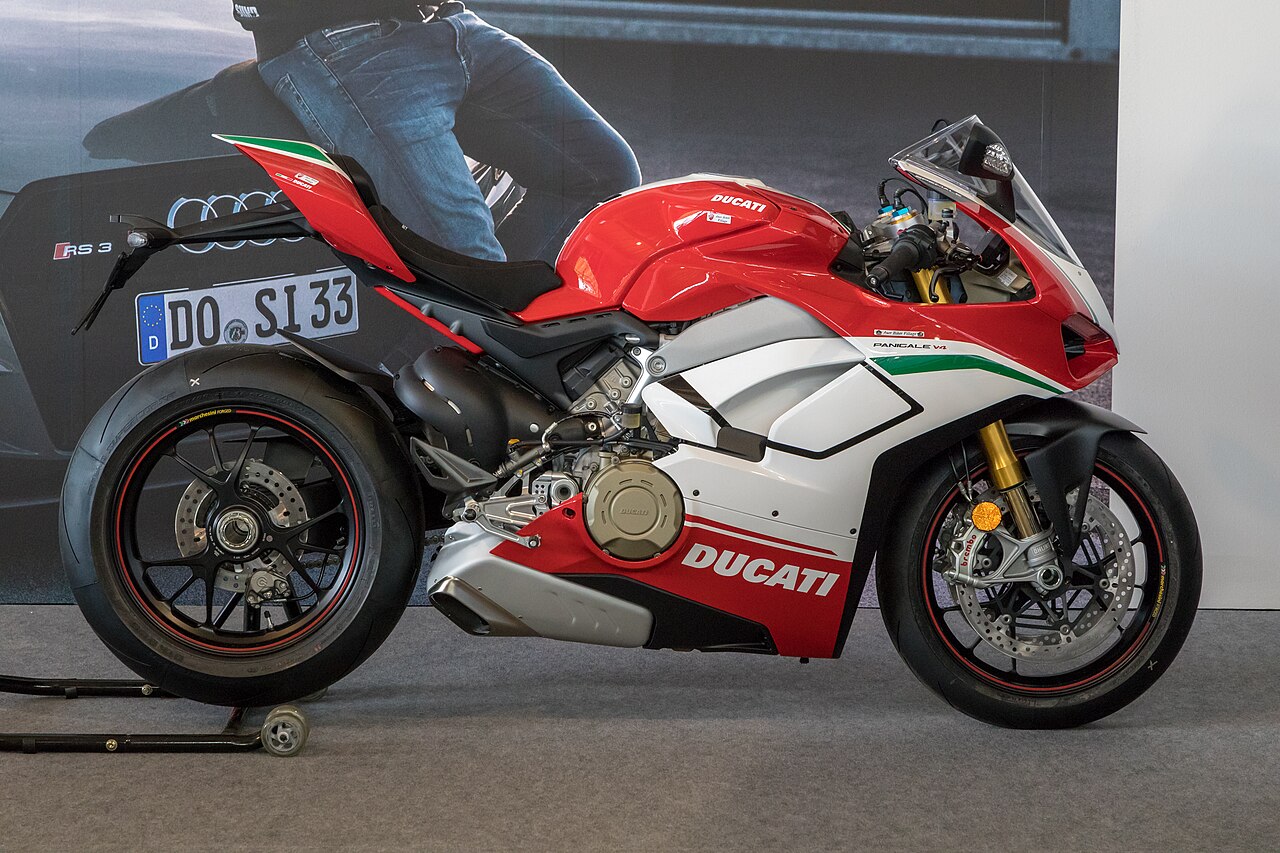
There are fast motorcycles, and then there is the Panigale V4 — a machine that behaves less like a road bike wearing a number plate and more like a Desmosedici GP racer that took a wrong turn out of the pit lane. Thumb the starter and the 1103 cc V4 settles into a lumpy, uneven idle, a deliberate reminder that Ducati borrowed this engine’s counter-rotating crankshaft and firing order straight from the Grand Prix paddock.
For 2025 the Panigale has been honed rather than reinvented, and the result is the most complete superbike Borgo Panigale has ever built. It flatters the quick, forgives the brave, and never once lets you forget that its natural habitat is a circuit with run-off measured in acres rather than metres. Ride it gently and it simmers; open it up and it detonates.
An engine ripped from the Grand Prix grid
The Desmosedici Stradale is the undisputed star. Ninety degrees of liquid-cooled V4 fury spins hard towards 14,000 rpm and serves a claimed 214 hp, arriving with a top-end rush that seems to compress the horizon towards you. Below 8,000 rpm the motor is tractable, almost civil; beyond that the counter-rotating crankshaft and desmodromic valvetrain conspire to hurl you forward with a violence few road vehicles on earth can match.
The headline figures tell only part of the story — 2.9 seconds to 100 km/h and a top speed brushing 300 km/h — because it is the delivery that truly lingers in the memory. The V4 howls where a Japanese inline-four merely screams, a hard-edged bark that turns every underpass into a private concert hall. The up-and-down quickshifter is close to telepathic, and the ride-by-wire throttle stays precise enough to trust at full lean.
Two hundred and eight horsepower. No fairing. A handlebar instead of clip-ons, and a riding position that puts your chin roughly where a superbike rider’s chest would be. On paper, the Ducati Streetfighter V4 reads like a dare: take the beating heart of the Panigale, strip away the aerodynamics and the excuse for a full tuck, and hand the whole savage package to a rider sitting bolt upright with nothing to hide behind. I have now lived with one long enough to answer the only question that actually matters, which is not whether it’s fast, because obviously it is, but whether 208 hp in a naked bike is something a normal road rider should actually want to own.
The short answer is complicated, and anyone who tells you it’s simple either hasn’t paid for a desmo service or hasn’t sat in traffic in July with a 90-degree V4 idling between their knees. Every publication on earth has already told you what this bike can do on an empty mountain road at nine in the morning, and that story is true. This is the other story: what it’s actually like to own the thing, day after day, on the roads the rest of us actually ride.
Two Hundred Horsepower You Will Almost Never Use
Let’s deal with the headline figure first, because it’s the reason most buyers walk into the showroom. 208 hp at 12,750 rpm sounds like a number built for bragging rights, and mostly, it is. On the road, any road, in any country with a speed limit and other people on it, you will use perhaps the bottom third of that rev range for well over ninety percent of your riding. The other two-thirds exists for track days, for the one clear straight you find twice a year, and for the story you tell at the pub.
What you actually feel, hour after hour, is the mid-range shove: the way the Desmosedici Stradale hauls from 4,000 rpm with a violence that makes a 100-hp naked feel unfinished by comparison. That part of the case for this bike is real, and I won’t argue against it. Third-gear roll-ons out of roundabouts are genuinely intoxicating, and no lesser naked I’ve ridden replicates the sensation of this V4 loading up under your right wrist at half throttle. But the peak number on the spec sheet is bragging-rights power, not usable power, and pretending otherwise is how riders end up buying far more bike than their actual riding calls for. Ask yourself honestly how many times a year you’ll see an indicated 150 mph on a public road with your licence intact — if the answer is never, you are paying, in purchase price, in insurance, in every service invoice, for a top end you are buying purely to know it exists.
Living With a Desmodromic Heart
The Desmosedici Stradale is a mechanical masterpiece and also, by any sane measure, overkill for a bike that mostly does the school run. Ducati’s desmodromic valve system doesn’t use springs to close the valves; it uses a second set of cams to physically shut them, which is part of why this engine can spin so hard and so cleanly toward its redline. It’s also why it demands attention a Japanese inline-four simply doesn’t.
The valve-clearance check, the big and genuinely expensive one, where the tank comes off and a technician gets intimate with the cylinder heads, now falls at a 24,000 km (roughly 15,000-mile) interval on this generation of engine. That’s a real improvement on older desmo Ducatis, and the brand deserves credit for stretching it. But “improved” is relative. That single service, even on a generous interval, will cost meaningfully more than a whole year of running something like a Z900 or an MT-09, and you’ll still be doing oil and filter work on a shorter cycle in between. Budget for it the way you’d budget for a set of tyres you didn’t ask for.
None of this makes the Streetfighter unreliable. Desmo engines are famously robust between services, not fragile. It makes it a bike that asks you to think like the owner of something exotic, even though it looks, sounds and rides like a street bike you could commute on. The same mechanical sophistication that makes this engine so thrilling above 8,000 rpm is the sophistication billing you every time it goes in for work.
Traffic Is Where This Bike Punishes You
Nobody buys a 208-hp naked to sit in traffic, and yet that is exactly where most owners will spend an uncomfortable share of their riding life. The Panigale at least has a fairing to route hot air away from your legs; the Streetfighter has almost nothing between the rear cylinder bank and your inner thigh, and a V4 running rich at idle to keep emissions in check throws real heat. On a cool commute it’s a non-issue. Stuck at a red light in summer, with the radiator fan cycling and the exhaust baking your calf, it becomes exactly the kind of discomfort that makes you question the whole purchase.
The riding position compounds it. Ducati has softened the reach to the bars compared with the Panigale, and it genuinely is more upright, but this is still a committed sportbike wearing a naked’s clothes: a decent stretch to the tank, a firm seat tuned for track feedback rather than forty-minute commutes, and suspension that transmits every expansion joint and pothole with an honesty your spine did not request. Around town, on a lane-splitting commute, the Streetfighter is a chore in a way the Panigale never pretends not to be, and a lesser naked never becomes in the first place.
The Insurance Conversation Nobody Warns You About
Insurers don’t care that you’ll ride sensibly. They see a three-figure horsepower number attached to an exposed riding position, with none of the fairing that even marginally protects a superbike rider’s legs in a low-speed drop, and they price the policy accordingly. Add a naked’s higher theft appeal, since there’s no bodywork to make it instantly identifiable once the plates come off, and the premium on a Streetfighter V4 routinely lands well above what an equivalent-value adventure bike or a mid-weight naked would cost to cover, sometimes by a genuinely startling margin depending on your age, postcode and claims history.
This is the ownership cost almost nobody mentions in the glossy first-ride pieces, because a journalist testing a press bike for a week never sees a renewal quote land on the doormat. Anyone actually signing the finance agreement should get a real number before they get emotionally attached to the colour options. Here is what actually changes, in practical terms, once you sign on the dotted line:
- Fuel range shrinks fast once you start using the top of the rev range; this is not a bike built for long stints between stops.
- Tyres wear quickly under that much torque, so budget for a fresh rear sooner than you’d like.
- Desmo servicing means planning ahead for a specialist technician, not just whichever mechanic is nearest.
- Heat soak in slow-moving traffic is a genuine, recurring discomfort, not an occasional inconvenience.
- Insurance premiums reflect the power figure and the naked bodywork, not just the price tag on the invoice.
The Streetfighter V4 doesn't want a commute. It wants a racetrack, a full tank and a very understanding insurer — everything else is just where it lives when it isn't allowed to be itself.— Marcus Vale, Chief Road Tester
Streetfighter vs. Panigale vs. a Sensible Naked
So where does that leave a buyer cross-shopping this against its own siblings? Against the Panigale V4, the case for the Streetfighter is straightforward. You get almost the same soul, 208 hp against the Panigale’s 214 hp, the same desmodromic heart, with a riding position that won’t wreck your wrists on the way to work. If you want the V4 experience but refuse to fold yourself into a race crouch every single day, the Streetfighter is the obviously correct choice, and the money saved over the Panigale’s asking price barely matters next to how much more you’ll actually ride the thing.
Against a lesser naked, a Triumph Street Triple 765 RS, a Yamaha MT-09, even KTM’s own 1390 Super Duke R, the calculation gets far less comfortable. These bikes deliver eighty or ninety percent of the real-world thrill on a normal road, cost meaningfully less to buy, insure and service, and don’t punish you for simply existing in traffic. The gap between a Street Triple’s mid-range and the Streetfighter’s top-end fireworks is something you’ll feel for maybe four seconds on your favourite stretch of B-road, and pay for every single day in between.
If you ride mostly on the road, at speeds a well-tuned 100-to-120 hp naked handles with total confidence, and you’re honest about how rarely you’ll explore the top third of this engine’s rev range, a lesser naked will make you happier per pound spent. The Streetfighter V4 earns its keep only for the rider who genuinely wants, and will genuinely use, the full V4 experience at a track day or on an empty pass somewhere, and who has already made peace with what that costs on every ordinary day in between.
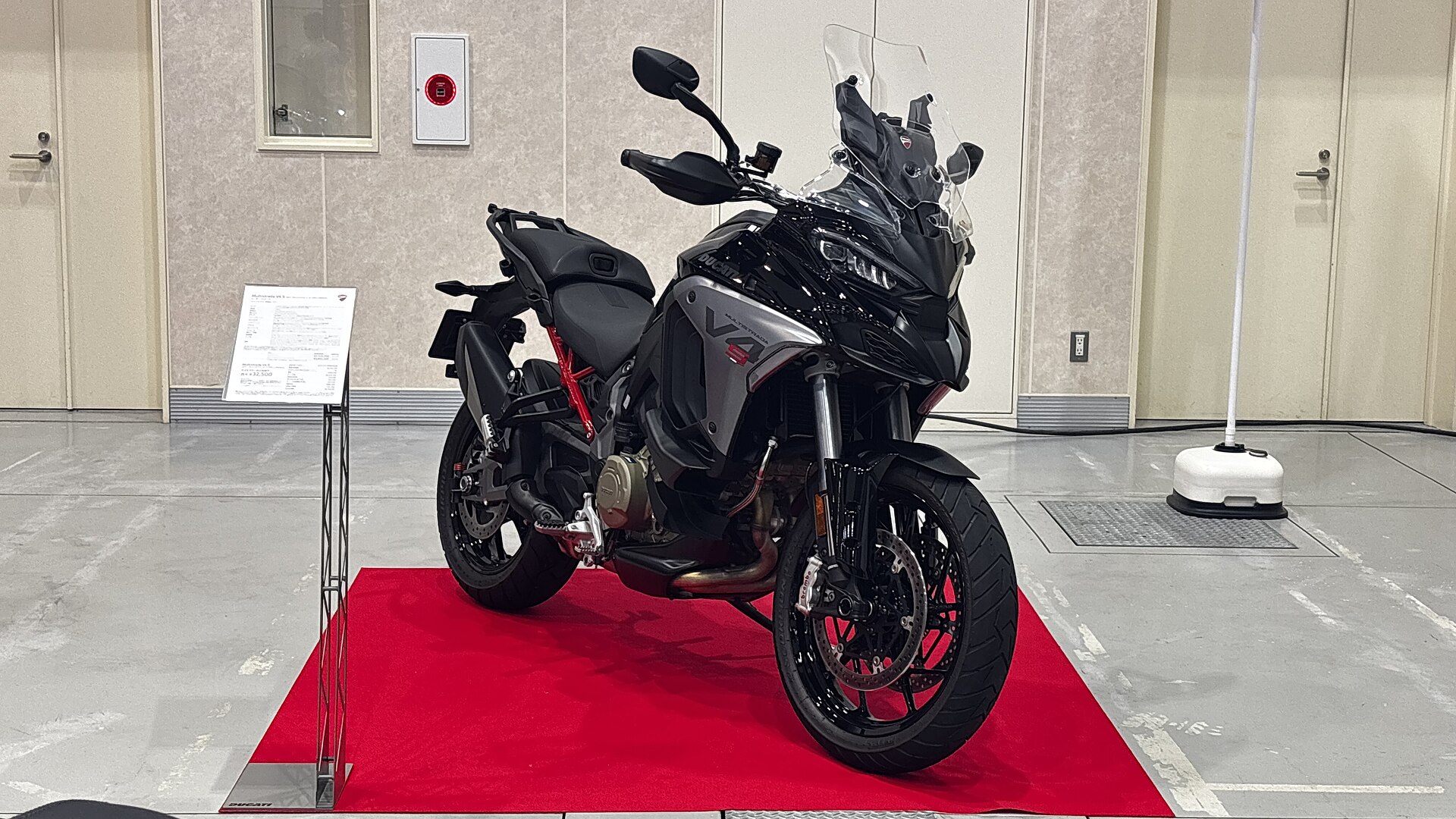
The premise of the Multistrada V4 sounds impossible: take the ferocious performance of a Ducati superbike, wrap it in the comfort and range of a long-distance tourer, and add just enough adventure-bike stance to tackle a gravel road. Somehow, improbably, Ducati has pulled it off. This is a machine that will devastate a mountain pass in the morning and cosset you across a country by nightfall.
It is the ultimate do-everything motorcycle for riders who refuse to compromise on pace, and it represents a genuine leap over the V-twin Multistradas that came before. The switch to a V4 changed the bike’s entire character — smoother, faster, and, crucially, far easier to live with day to day.
The Granturismo V4: pace and patience
The 1158 cc V4 Granturismo is a marvel of dual personality. It produces a thumping 170 hp and 125 Nm, enough to fire the Multistrada to 100 km/h in around 3.2 seconds and on to a 250 km/h top speed, with a spine-tingling V4 wail when you chase the redline. This is genuine superbike performance, delivered from an upright and comfortable seat.
Yet the same engine is a model of civility when you want it to be, pulling smoothly from low revs and cruising with unruffled ease. The masterstroke is its maintenance: Ducati quotes an astonishing 60,000 km valve-check interval, banishing the costly, frequent servicing that once haunted its high-performance machines and making the V4 a genuinely sensible long-distance proposition.
There is no polite way to stage this fight. On one side stands the Ducati Panigale V4, Bologna’s rolling statement of intent — a machine built to translate MotoGP obsession into something you can, in theory, ride to breakfast. On the other sits the BMW M 1000 RR, the German answer to a very Italian question, engineered with the cold precision of a company that treats lap time as a moral duty. Both are homologation heroes, both cost more than a family car, and only one can reign over your fantasy garage.
What makes this comparison so delicious is that the two chase the same summit by opposite paths. Ducati leans on drama, exclusivity and a V4 soundtrack that raises hairs. BMW leans on data, downforce and a relentless will to be faster everywhere. We rode both back to back, on road and on circuit, and came away convinced that the right answer depends less on the bikes than on the person twisting the throttle.
Engine and performance
The Panigale’s 1,103cc Desmosedici Stradale is the emotional heart of this test. Its counter-rotating crankshaft, deep V4 howl and roughly 215 hp arrive with a violence that feels almost alive, the front wheel skimming the tarmac as it charges toward 13,000 rpm. Torque peaks near 124 Nm, and the delivery is broad enough to flatter a road rider yet savage enough to frighten one. This is an engine that performs for you as much as it propels you, filling your helmet with a sound that no inline-four can match.
BMW counters with a 999cc inline-four packed with ShiftCam variable valve tech, spinning to a dizzying 14,500 rpm for a claimed 212 hp. On paper the numbers sit close; in character they live in different countries. The M feels turbine-smooth and metronomic, gathering pace with a clinical shove that simply never relents. Where the Ducati shouts, the BMW gets on with the job, and at the top of the tacho it arguably pulls harder. Both crack 300 km/h with room to spare, and both leave litre-class rivals looking distinctly ordinary.
Chassis and handling
Ducati’s front-frame concept uses the engine as a stressed member, and the latest Panigale finally adopts a double-sided swingarm lifted straight from racing. The result changes direction on a thought — wonderfully intimate and communicative once you trust it. The M 1000 RR, heavier by a whisker at around 192 kg wet, feels more planted and forgiving, its aluminium bridge frame and aggressive winglets pinning the front through fast sweepers with uncanny stability. Both wear elite Brembo-grade braking hardware that hauls speed off with brutal, fade-free authority lap after lap.
These two are not quite the same size, and that is precisely the point. The Triumph Tiger 900 is a mid-capacity adventurer that punches above its weight; the Ducati Multistrada V4 is a full-fat superbike-engined tourer that happens to wear knobbly-capable rubber. Cross-shopping them is really a question about how much bike — and how much budget — your adventures truly demand, and whether more of everything is always better.
One is light, agile and refreshingly honest. The other is fast, opulent and stuffed with technology that would embarrass a luxury saloon car. Both are superb machines; they simply serve very different appetites and very different bank balances.
Engine and performance
The Tiger 900 uses Triumph’s charismatic 888cc T-plane triple, an engine that produces a burbling, off-beat exhaust note and around 108 hp with 90 Nm. It feels torquey and tractable, ideal for gravel where a smooth, predictable delivery matters more than outright grunt. The Multistrada’s 1,158cc V4 Granturismo is another animal entirely: 170 hp, 125 Nm and a rush of acceleration that makes the Ducati feel like a naked sportbike wearing a rucksack and touring luggage.
On the open road the Multistrada is savagely, almost comically fast for the genre, while the Tiger is merely quick. But the Ducati’s V4 also runs impressively long service intervals and cleverly shuts down its rear cylinders in traffic to keep the rider cool. The Tiger, meanwhile, delivers all the performance most riders will ever use, with a warmth of character the bigger, more clinical bike cannot quite match on a favourite road.
Chassis and off-road
At roughly 201 kg in Rally trim the Tiger is significantly lighter than the circa-240 kg Multistrada, and off-road that difference is decisive. The Tiger’s 21-inch front wheel, long-travel suspension and manageable mass make it genuinely trail-capable in the hands of a keen rider. The Multistrada is more of a road-biased grand tourer; its optional off-road-focused versions with spoked wheels help, but its sheer weight always reminds you exactly what it is when the surface loosens.