Every year, tens of thousands of new riders in the UK pass their CBT, walk into a dealership or scroll through a marketplace listing, and make exactly the same mistake. They buy the cheapest 125cc scooter on the lot, congratulate themselves on the saving, and ride off into three years of quietly haemorrhaging money. It feels like the sensible decision. It is almost never the cheap one. I have watched this play out at dealerships, in comment sections and in my own inbox often enough to know it is not a one-off blunder — it is the default UK commuter mistake.
I have run these numbers for readers, for mates buying their first bike, and for my own commute, and the pattern never changes. The scooter that costs £700 to £1,000 less on day one is very rarely the one that costs less by the time you come to sell it. Spend a little more up front, on a proper 125 to 160cc commuter rather than the bottom-of-the-barrel option, and the maths swings back in your favour almost every time. This is the opinion piece I wish someone had handed me before my first scooter purchase, and it is the one I now repeat to anyone who will listen.
The False Economy of the Cheapest 125
The sticker price is the only number most first-time buyers actually compare, and dealer finance adverts make that worse by quoting a weekly payment instead of a total cost. But a scooter is not a single transaction. It is a three-year subscription made up of insurance, fuel, servicing and whatever you eventually claw back at resale, and the purchase price is only the entry fee. Ask to see the honest out-the-door cost over three years rather than the number chalked on the showroom window, and the picture usually looks very different.
Cheap scooters are usually cheap for structural reasons, not because a manufacturer has found some clever efficiency. Thinner components, unproven engines, patchy parts supply and a name nobody at the used-bike counter recognises all show up later as bigger bills or a resale offer that makes you wince. None of that is a moral failing on the buyer’s part — it is simply what a rock-bottom price has to sacrifice somewhere, and it is rarely obvious which corner has been cut until you are the one paying to fix it. The saving you banked in month one has a habit of reappearing, with interest, in month thirty-six.
Your Licence Tier Changes the Sums
Here is the detail that trips people up most. If you are riding on a CBT certificate with L-plates, or you have passed your A1 test, you are legally capped at 125cc and 11kW regardless of what you buy. In that world, more money does not buy more legal performance, and it is tempting to conclude the cheapest 125 is therefore just as good as any other. It is not — you are still choosing between brakes that work properly and brakes that just about work, between an engine that sips fuel and one that gulps it, and between a bike that will still be worth something in three years and one that will not.
If you already hold a full A2 licence, or you are working towards one, the argument gets even stronger. You have room to step up into the 150 to 300cc class — machines like the Honda PCX160 or Vespa GTS 300 — and that extra displacement buys real, usable headroom: confident dual-carriageway cruising, genuine pillion capability, and a bike that does not feel flustered the moment a slip road appears. For a rider who has outgrown a starter 125, that is where the smart upgrade money actually goes, rather than into a flashier paint job on the same small-bore engine.
Insurance: The Second Price Tag Nobody Budgets For
For a new or young rider, an annual insurance premium can rival the cost of the bike itself, and it is the figure almost nobody checks before they fall in love with a listing. Premiums swing wildly with age, postcode and no-claims history, but crucially, price and premium do not track each other neatly within that picture. A scooter’s insurance group depends on theft risk, claims history and how expensive its parts are to source, not simply on what you paid for it.
This cuts against the bargain-bin instinct in an interesting way. Popular commuter models from established names carry proper immobilisers, steering locks and a dealer network that keeps parts flowing, all of which insurers reward. An anonymous budget import, by contrast, can land in a surprisingly similar group despite costing half as much, because insurers have no confidence in its security or its claims history. Run the same rider and the same postcode through a comparison site against both bikes before you buy, not after, because the cheap bike is frequently no cheaper to cover.
Fuel Economy Over a Real Commute
A typical UK scooter commute is not exotic: a handful of miles each way, most days of the working year, adding up to somewhere in the region of 5,000 to 6,000 miles annually for a lot of riders, or roughly 15,000 to 18,000 miles across three years. That is more than enough distance for a gap in fuel economy to turn from a rounding error into a real number on a bank statement. A tired, carburetted budget 125 will often struggle to beat 65 to 75 mpg in real commuting use, whereas a modern, fuel-injected 150 to 160cc machine like the PCX160 can comfortably clear 120 mpg, with the Vespa GTS 300 landing a little behind that at closer to 80 mpg for its extra performance. Run those figures across three years of commuting miles at current UK pump prices and the efficient bike can plausibly save you several hundred pounds in fuel alone, money the cheap scooter quietly spent on your behalf, one tank at a time.
For the better part of two decades, the electric motorcycle was treated as a science-fair exhibit — earnest, faintly awkward, and forever promising to be brilliant next year. The bikes were heavy, the range was laughable, the price tags read like a cruel joke, and the whole category smelled of compromise. Enthusiasts nodded politely at the trade-show stands, admired the clever packaging, then rode home on something that burned petrol and made a proper noise. For years that was the honest state of play. It is not any more. Somewhere in the last few model cycles the electric motorcycle stopped being a proof of concept and quietly, decisively grew up into a machine you would choose on merit alone.
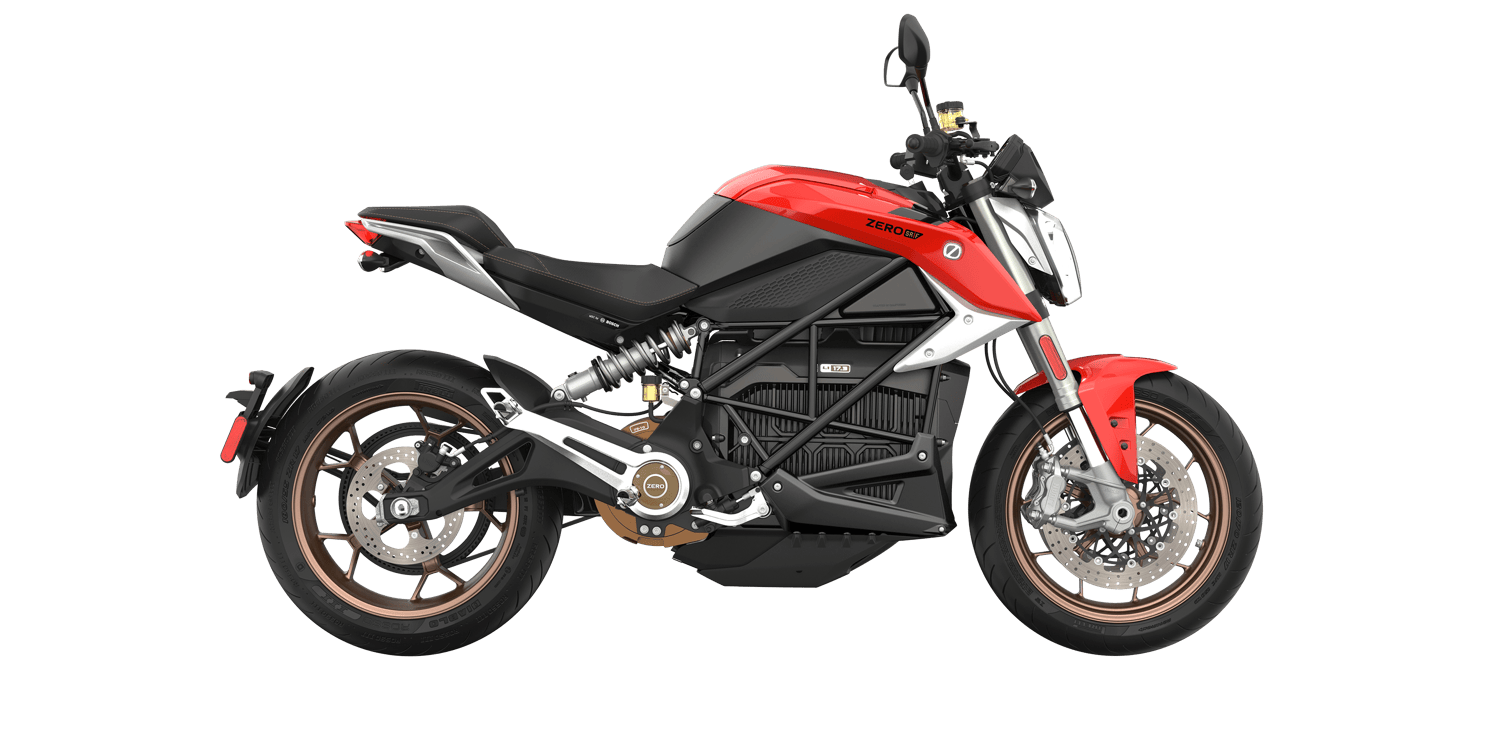
Nothing captures that shift better than a bike like the Zero SR/F. This is not a curiosity you tolerate for the sake of your conscience; it is a genuinely quick, genuinely usable motorcycle that happens to be silent. Throw a leg over one after a lifetime of combustion machines and the first surprise is how utterly normal it feels — the riding position, the switchgear, the reassuring heft in your palms — right up until the moment you crack the throttle and the road behind you simply vanishes into the distance.
From Novelty to Serious Machine
The early electrics asked riders to make sacrifices and then feel virtuous about them. Today’s flagships ask for almost nothing. Build quality now matches the Japanese and European mainstream, and the component sheets read like a proper superbike: Showa suspension front and rear, J.Juan brakes biting big rotors, sticky Pirelli Diablo Rosso rubber wrapped around a steel-trellis frame. The software is where the real leap has happened. The SR/F runs a full ride-by-wire system with configurable power, torque and regeneration maps you tune from a phone app, so a single bike can behave like a docile commuter on Monday morning and a snarling backroad weapon on Sunday afternoon. That kind of split personality, delivered without a single mechanical change, simply does not exist in the combustion world, where character is welded in at the factory and stays there.
Instant Torque Rewrites the Rules
The defining trait of an electric motorcycle is torque, and above all how it arrives. A combustion engine has to spin up, find its powerband, and be held there with clutch and gearbox. An electric motor delivers its peak twist from a dead standstill — the SR/F serves up a claimed 190 Nm the instant the rotor turns. There is no clutch to feed, no gear to select, no waiting for revs to build. Crack the throttle at any road speed, in any situation, and the bike simply lunges, hauling itself toward 100 km/h in around three seconds with no theatre and no sound but a faint electric whine and the roar of rushing air. The sensation sits somewhere between a litre-class superbike and a fairground ride, and it is deeply, gloriously addictive from the very first junction.
The first time an electric motorcycle launches beneath you in near-total silence, your brain simply refuses to accept that both things can be true at once — this much acceleration, and this little noise.— Priya Anand, Technology Editor
The Range Conversation, Honestly
Range remains the headline anxiety, and it deserves a straight answer rather than a sales pitch. A modern SR/F will return roughly 190 km of city riding from its 14.4 kWh pack — comfortably a week of commuting, errands and evening blasts for most riders. Push hard on the motorway, though, and that number tumbles fast, because sustained high speed and aerodynamic drag punish an electric drivetrain far more brutally than stop-start town work ever does. This is the exact inverse of a petrol bike, which sips fuel at a steady cruise and drinks it thirstily in traffic. Regenerative braking recovers energy every time you roll off or brake, so the busier and slower the road, the better the electric bike looks. Grasp that single flip in logic and most of the anxiety quietly evaporates.
- Daily city and suburban commuting, where regenerative braking claws back energy at every junction
- Short, intense weekend rides on twisting roads within a comfortable round trip of home
- Courier and delivery work, where silence, low running costs and instant response are real assets
- Riders with a garage socket who are happy to treat the bike like a smartphone and plug in overnight
Almost Nothing to Maintain
Here the electric case becomes genuinely hard to argue against. There is no oil to change, no valve clearances to shim, no clutch plates to burn out, no air filter to service, and on the SR/F a clean toothed belt replaces the greasy chain. A drivetrain that once needed hundreds of moving parts now uses a handful. Routine servicing amounts to little more than tyres, brake pads, brake fluid, and the occasional over-the-air software update delivered while the bike sleeps in the garage. For riders sick of dealer invoices, winter fettling and the endless ritual of chain lube, that alone is a powerful reason to switch camps. The motor itself, with a single moving part at its heart, should comfortably outlast the chassis wrapped around it.