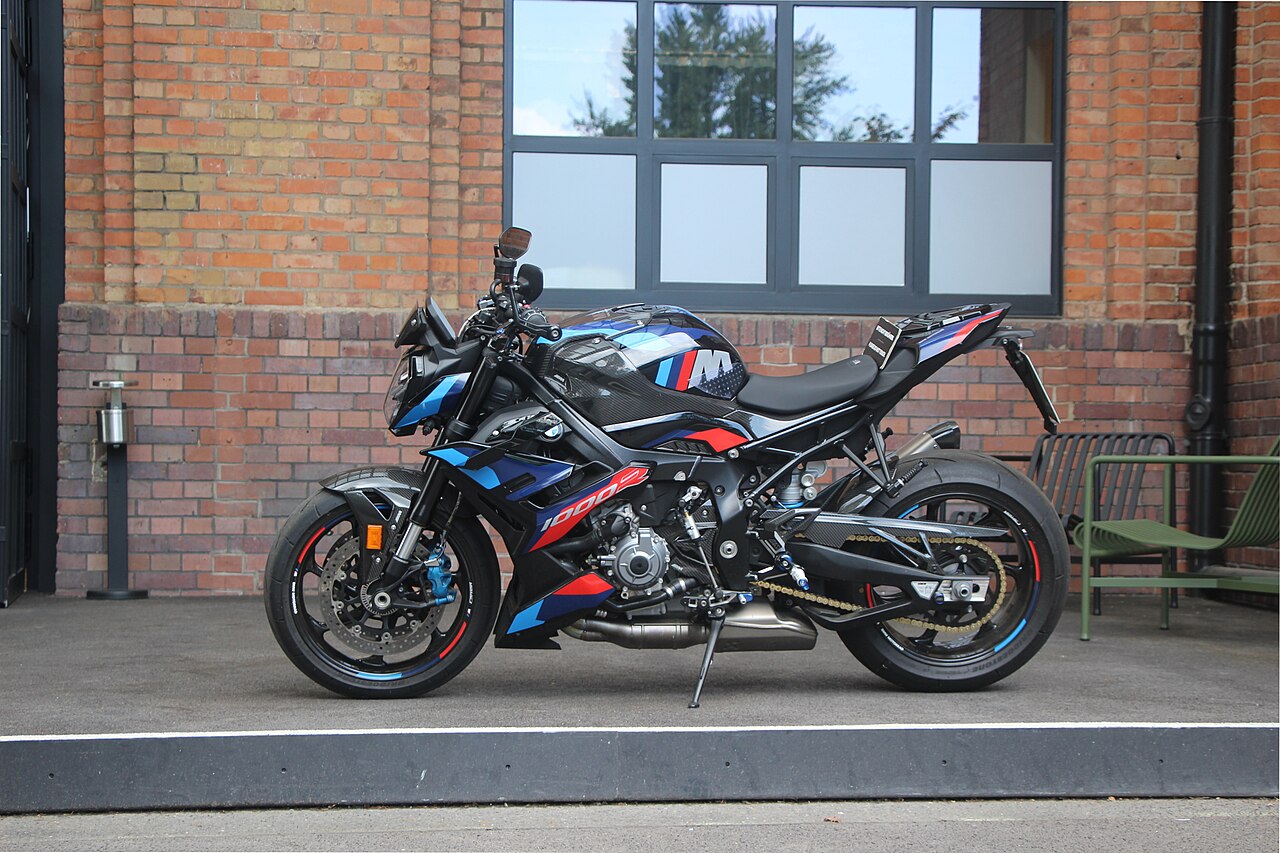
The M badge means something specific in Munich. On four wheels it signals a car engineered to devour a racetrack yet still cruise home in comfort, and the M 1000 RR carries that same philosophy onto two. This is not merely a hotted-up S 1000 RR; it is a homologation special, built so BMW’s factory riders have a weapon worthy of World Superbike, then handed to us with lights and mirrors bolted on.
Where the Ducati seduces with operatic theatre, the BMW conquers with cold, ruthless efficiency. It is the fastest-accelerating, highest-topping superbike in this test, and it feels engineered by people who treat every tenth of a second as a personal insult. On the right stretch of derestricted autobahn, nothing here comes close.
ShiftCam power without the peaks and valleys
The 999 cc inline-four is the headline act. BMW’s ShiftCam variable valve timing hands the M a genuinely broad spread of torque, so the 212 hp peak at 14,500 rpm never feels like a distant reward. There is meaningful drive from 6,000 rpm, a surging midrange, and then a top-end crescendo that pins your visor to the screen and refuses to let go until the limiter chimes.
The numbers are frankly absurd for a road-legal machine: 3.0 seconds to 100 km/h and a genuine 306 km/h maximum. Yet the delivery is so linear, so utterly predictable, that it flatters rather than frightens. The M quickshifter snaps through the six-speed box with mechanical crispness, and the induction howl at full chat is one of motorcycling’s great sensory rewards.
For decades the big boxer GS has been the default answer to a simple question: if you could own only one motorcycle to ride anywhere on earth, what would it be? The R 1300 GS does not merely defend that title — it moves the goalposts. BMW has thrown out the old 1250 architecture, grown the engine, shrunk the waistline and reimagined the electronics, and the sum is genuinely transformative.
Swing a leg over and the first surprise is how compact it feels for such a capable long-hauler. The new frame is narrower, the mass sits lower, and a bike that once demanded respect at walking pace now feels almost eager to be flicked around. This is a GS that has finally learned to hide its bulk.
A bigger boxer with better manners
The air- and liquid-cooled flat-twin now displaces 1300 cc and produces 145 hp with a muscular 149 Nm of torque, and the way it deploys that grunt is the GS masterstroke. There is a wall of drive from just above idle, so overtakes require nothing more than a roll of the wrist, and the characterful boxer thrum still shakes the mirrors at a standstill before smoothing out on the move.
It is not a screamer and does not want to be. Peak power lands at a relaxed 7,750 rpm, and the engine is happiest short-shifting and surfing that fat wave of torque across a mountain range. Fully loaded, two-up, with panniers stuffed, it barely notices the difference — which is precisely the point of a machine built to swallow continents.
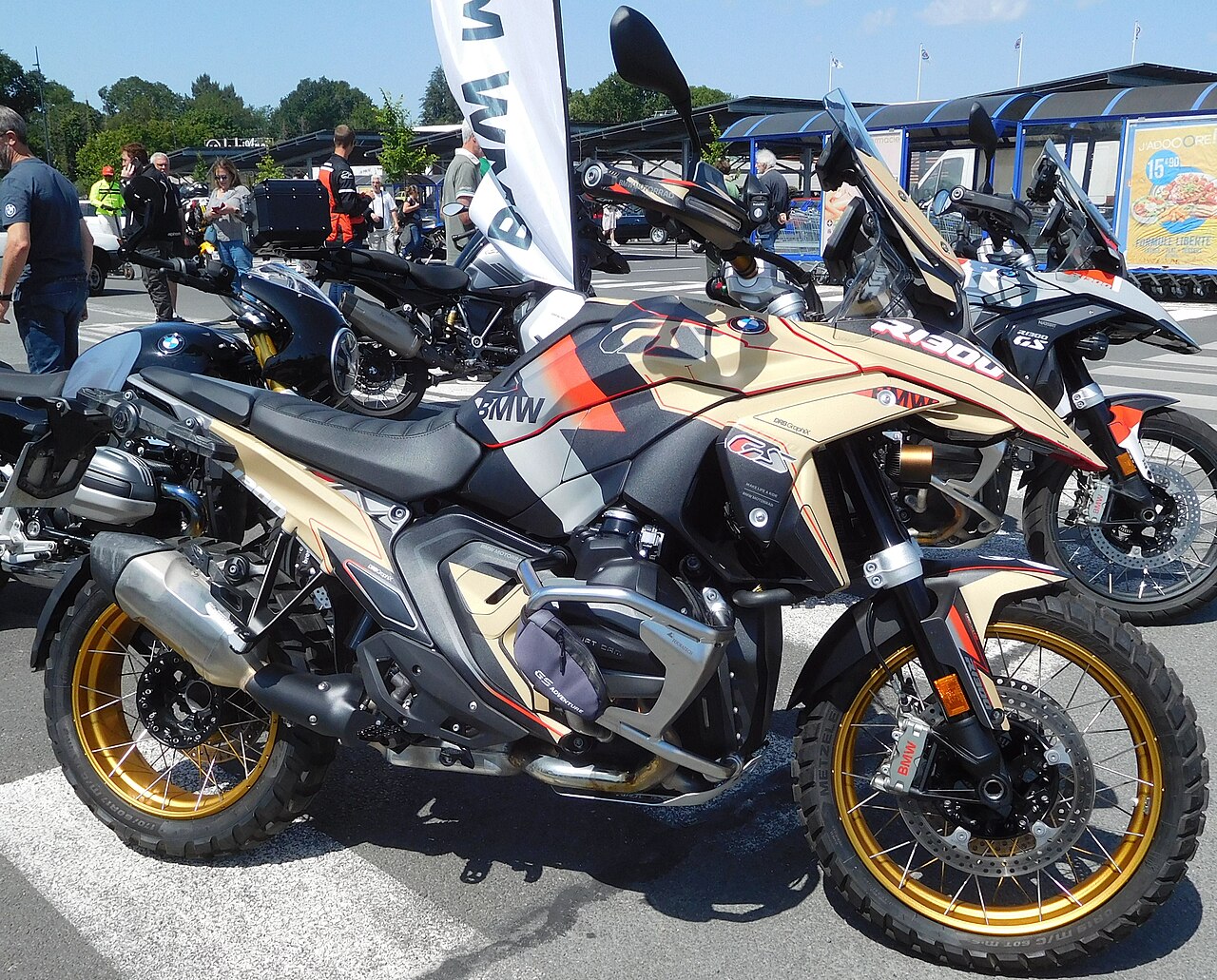
Ask ten riders to name the best all-round motorcycle on sale and most of them will say the same three letters: GS. Ask ten owners who actually live with one on wet, congested, pothole-scarred British roads what it is actually like day to day, and you get a far more complicated answer. I have spent the best part of a year running a BMW R1300GS as my only bike through a UK winter, a UK summer and every kind of traffic Britain can throw at a motorcycle, and I have some things to say that the brochure conveniently leaves out.
None of it changes the fact that this is a phenomenal motorcycle. That is precisely what makes it worth talking about honestly. The GS is sold, and often reviewed, as the machine that does everything — comfortable enough for Cornwall to the Cairngorms in a day, tech-laden enough to feel like the future, and still, allegedly, an off-road adventurer at heart. Live with one daily in the UK, though, and three uncomfortable truths surface fast: it is heavy, it is expensive to keep fed with tyres, and BMW’s idea of a service bill is not quite the same as yours or mine. None of that makes it a bad bike. It makes it a bike you need to go into with your eyes open.
The Weight You Feel At Every Set Of Lights
On paper, 237 kg kerb weight doesn’t sound especially alarming — plenty of tourers and cruisers carry more. On a UK high street at 8:40 on a Tuesday morning, hemmed in by white vans and roadworks, it feels like a great deal more than the number on the spec sheet suggests. The GS carries its mass high and a long way from the ground, and while BMW’s excellent Telelever front end and the optional adaptive ride height do a genuinely impressive job of disguising that weight once you’re rolling, none of that clever engineering helps much at a dead stop on a cambered junction with a delivery driver leaning on his horn behind you. The seat drops as you slow and rises again once you’re moving, which is a genuinely clever party trick for shorter riders — it just does not make the bike any lighter to actually manhandle.
Filtering is where the compromise really bites. Britain, unlike much of Europe, actually lets you filter through queued traffic, and it is one of the great everyday joys of commuting by bike here. Do it on a GS for any length of time and your shoulders and forearms will know about it by Friday. The bars are wide, the mirrors stick out further than you would like between two lines of wing mirrors, and hustling 237 kg through a gap that a Yamaha MT-07 rider barely notices requires a level of commitment, and a level of low-speed clutch control, that plenty of riders never build up simply because they never need to on anything smaller. It is not badly engineered; it is simply engineered for motorways, not Camden on a Friday evening.
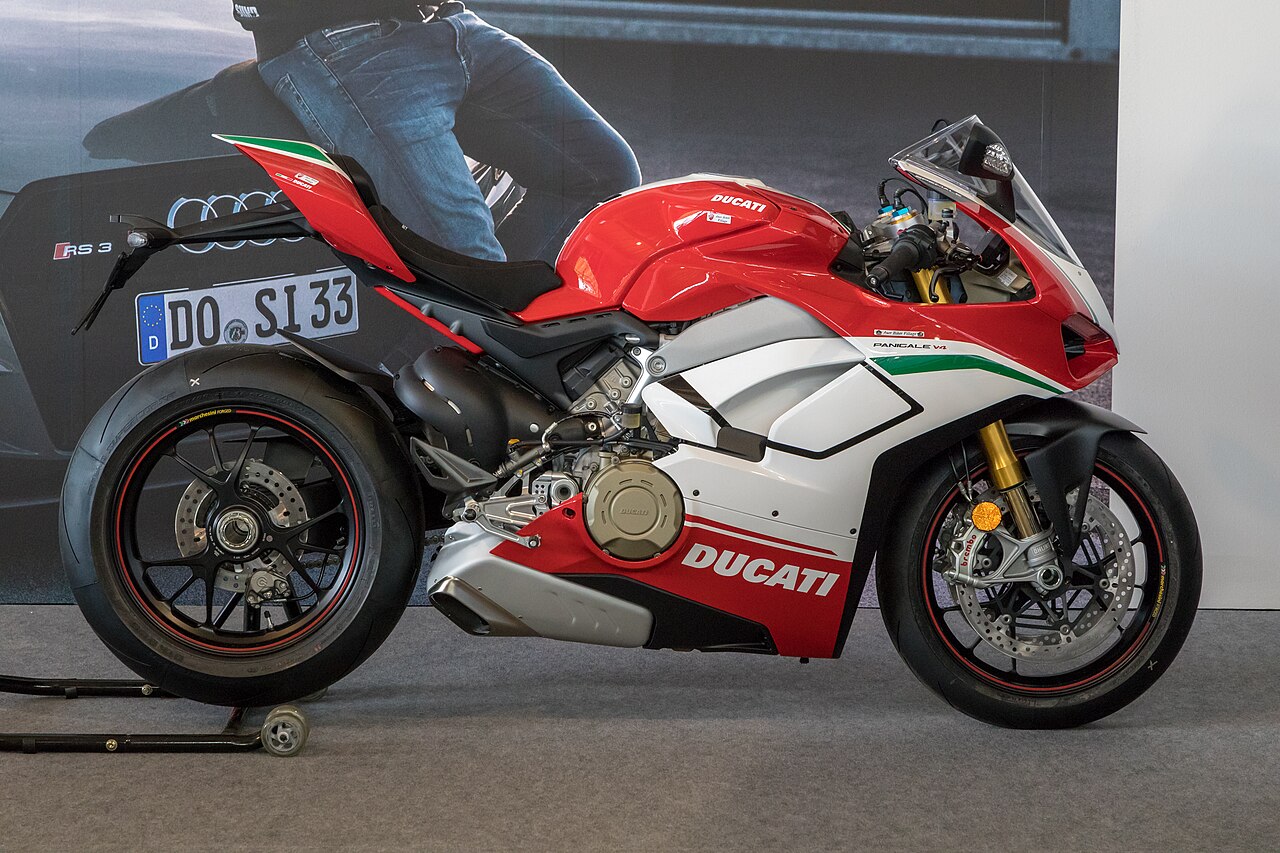
There is no polite way to stage this fight. On one side stands the Ducati Panigale V4, Bologna’s rolling statement of intent — a machine built to translate MotoGP obsession into something you can, in theory, ride to breakfast. On the other sits the BMW M 1000 RR, the German answer to a very Italian question, engineered with the cold precision of a company that treats lap time as a moral duty. Both are homologation heroes, both cost more than a family car, and only one can reign over your fantasy garage.
What makes this comparison so delicious is that the two chase the same summit by opposite paths. Ducati leans on drama, exclusivity and a V4 soundtrack that raises hairs. BMW leans on data, downforce and a relentless will to be faster everywhere. We rode both back to back, on road and on circuit, and came away convinced that the right answer depends less on the bikes than on the person twisting the throttle.
Engine and performance
The Panigale’s 1,103cc Desmosedici Stradale is the emotional heart of this test. Its counter-rotating crankshaft, deep V4 howl and roughly 215 hp arrive with a violence that feels almost alive, the front wheel skimming the tarmac as it charges toward 13,000 rpm. Torque peaks near 124 Nm, and the delivery is broad enough to flatter a road rider yet savage enough to frighten one. This is an engine that performs for you as much as it propels you, filling your helmet with a sound that no inline-four can match.
BMW counters with a 999cc inline-four packed with ShiftCam variable valve tech, spinning to a dizzying 14,500 rpm for a claimed 212 hp. On paper the numbers sit close; in character they live in different countries. The M feels turbine-smooth and metronomic, gathering pace with a clinical shove that simply never relents. Where the Ducati shouts, the BMW gets on with the job, and at the top of the tacho it arguably pulls harder. Both crack 300 km/h with room to spare, and both leave litre-class rivals looking distinctly ordinary.
Chassis and handling
Ducati’s front-frame concept uses the engine as a stressed member, and the latest Panigale finally adopts a double-sided swingarm lifted straight from racing. The result changes direction on a thought — wonderfully intimate and communicative once you trust it. The M 1000 RR, heavier by a whisker at around 192 kg wet, feels more planted and forgiving, its aluminium bridge frame and aggressive winglets pinning the front through fast sweepers with uncanny stability. Both wear elite Brembo-grade braking hardware that hauls speed off with brutal, fade-free authority lap after lap.
For decades the big adventure bike has been the Swiss Army knife of motorcycling — comfortable enough for continents, capable enough for gravel, fast enough to embarrass sports tourers. Two machines dominate the conversation. The BMW R 1300 GS is the reigning class benchmark, a technological tour de force that every rival is measured against. The Honda Africa Twin is the honest adventurer’s hero, less flashy but blessed with genuine dirt credibility and a price that makes the BMW blush.
This is not merely a spec-sheet duel. It is a clash of philosophies: German maximalism against Japanese pragmatism, gadgetry against grit. We took both across tarmac, gravel and rutted trail, loaded and unloaded, to find precisely where each one earns its keep and where its priorities lie.
Engine and performance
BMW’s all-new 1,300cc boxer twin is a monster in the friendliest way. With 145 hp and a colossal 149 Nm of torque, it hauls the GS forward with a locomotive shove that makes overtakes trivial and passengers grin. It is smoother and more urgent than any GS before it, with an addictive wave of low-down grunt. Honda’s 1,084cc parallel twin plays a quieter tune — 101 hp and 105 Nm — but its low, tractable delivery and 21-inch front wheel make it feel more natural when the surface turns loose and slippery.
On the road the BMW is simply quicker everywhere, and its optional Automated Shift Assistant lets you ride clutchless if you wish, blurring the line between manual and automatic. The Africa Twin, particularly with Honda’s superb DCT dual-clutch automatic, is the more relaxed companion, trading outright pace for a friendly, unflappable manner that suits long, dusty days far from a workshop. Neither engine will ever leave you wanting on a public road.
Chassis and off-road ability
The GS uses BMW’s evolved Telelever front end, which now offers adaptive ride-height control that lowers the seat at a stop and rises for clearance on the move — witchcraft that shrinks a heavy bike around you and makes a big machine feel manageable at the lights. It handles like something 50 kg lighter than it is. Yet the Africa Twin, with its longer travel, spoked wheels and genuine 21-inch front, remains the more confident tool once the tarmac ends and the ruts begin.