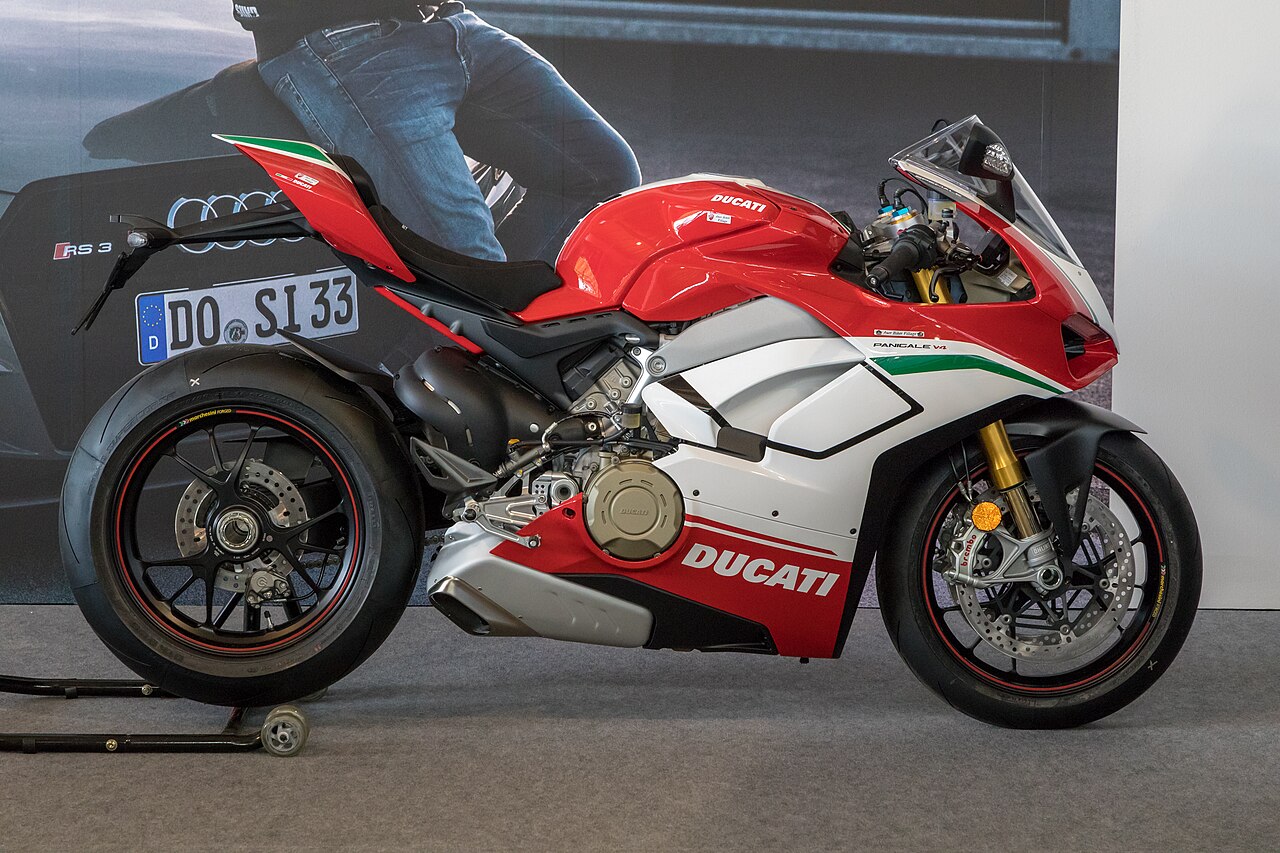
When aerodynamic winglets first sprouted from the fairings of MotoGP bikes, the reaction ranged from bemusement to open mockery. They looked like something bolted on by an over-enthusiastic modeller, all sharp edges and awkward carbon. A decade later, nobody is laughing. Those fins have become one of the most fiercely contested areas of Grand Prix development, absorbing millions in wind-tunnel and computational fluid dynamics work, and they have migrated onto road-going superbikes such as the Ducati Panigale V4. To understand why engineers fought so hard for them, you have to understand the specific problem a fast motorcycle faces when the throttle is pinned.
The short version is that a modern racing motorcycle makes more power than its front wheel can keep on the ground. Everything about winglets flows from that single, stubborn fact.
The Problem Aero Solves
A litre-class racing engine produces so much thrust that, under hard acceleration, the front wheel wants to lift clear off the tarmac. A rising front is slow and dangerous: it delays how early a rider can get on the power out of a corner, it makes the steering vague and nervous, and it forces the electronics to cut power to keep the bike from flipping. For decades the only answers were electronic wheelie control and the rider’s own delicate throttle hand, both of which sacrifice precious acceleration. Winglets attack the problem physically. By generating aerodynamic downforce on the front of the machine, they press the wheel down and let the rider deploy more power, sooner, with the electronics intervening less. The gain is measured in mere fractions of a second per lap, but over a full race distance those fractions decide championships, which is exactly why teams pursue them so relentlessly.
Downforce Without Wings, Then With
The principle is borrowed straight from car racing, where wings have generated downforce for half a century, but on a motorcycle it is fiendishly complicated by lean. A car’s wing works at a steady angle; a motorcycle spends much of its life banked over at sixty degrees, so a wing that presses down usefully on the straight behaves very differently through a corner. Engineers shape the winglets and the fairing so the aerodynamic load helps stabilise the bike both upright and leaned, adding front grip when hard on the brakes and steadying the machine through high-speed turns. It is a three-dimensional puzzle, and the answers are far from obvious, which is exactly why the development budgets are so vast. Wind tunnels and enormous computational-fluid-dynamics simulations now consume a huge share of a racing team’s resources, all to shape a few square inches of carbon that most spectators barely register.
People see ugly plastic fins. Aerodynamicists see hundreds of kilos of invisible force, pressing the front wheel into the tarmac exactly where the rider needs it most.— Sam Whitlock, Racing Editor
The Ducati Revolution
Ducati is the marque most associated with the aero era, and rightly so. Its engineers pushed winglets aggressively when rivals were still sceptical, endured the ridicule, and were vindicated as the lap times and their imitators piled up. The knowledge fed directly into the road-going Panigale V4, whose integrated aerodynamic fairings are not decorative flourishes but genuine downforce generators derived from the Desmosedici Grand Prix programme. On a bike making well over two hundred horsepower, that downforce helps keep the front planted under savage acceleration and improves stability at the enormous speeds the V4 is capable of reaching, giving a skilled rider a more usable, less intimidating machine at the limit. Rivals who once dismissed the fins have long since fitted their own, and the aerodynamic arms race Ducati started shows no sign of cooling on track or in the showroom.
What Winglets Cost You
Aerodynamic downforce is never free, and the engineering is a constant negotiation of trade-offs. Anything that presses the bike down also adds drag, blunting top speed and costing fuel, so every wing is a compromise between stability and slipperiness. Winglets add weight in the worst possible place, high and forward, and they change how the bike responds to side winds and to the turbulent air behind a rival machine, which affects overtaking. They also complicate crashes and raise safety questions, which is why governing bodies now regulate aerodynamic development tightly. Getting the balance right is precisely where the cleverest teams find their advantage, extracting downforce while paying the smallest possible penalty elsewhere. There is also the rider to consider, because heavy downforce changes how the bike steers and how it behaves in the dirty, turbulent air behind a rival machine, subtly reshaping the tactics of an entire race.
- Winglets press the front wheel down, taming wheelies under hard acceleration
- That lets the rider deploy power earlier with less electronic intervention
- They add front-end stability into fast corners and under heavy braking
- The cost is extra drag, added weight up high, and trickier turbulent air
- Regulators now police aero closely on grounds of cost and safety
Ground Effect and the Belly
The frontier has moved on from simple fins to the whole shape of the machine. Engineers increasingly work the underside and the belly of the fairing, chasing so-called ground effect and managing how air flows beneath and around the bike, not just over a pair of wings. Rear-end aerodynamic devices and carefully sculpted tail sections now play their part too, and the visible winglets are only the most obvious tip of a much larger aerodynamic effort. This is why modern race bikes look so busy and complex compared with the clean fairings of twenty years ago: almost every surface is now doing aerodynamic work rather than merely covering the mechanicals. Expect the trend to continue, with future machines devoting ever more of their bodywork to managing airflow, and expect the road bikes to inherit those hard-won lessons a season or two later.