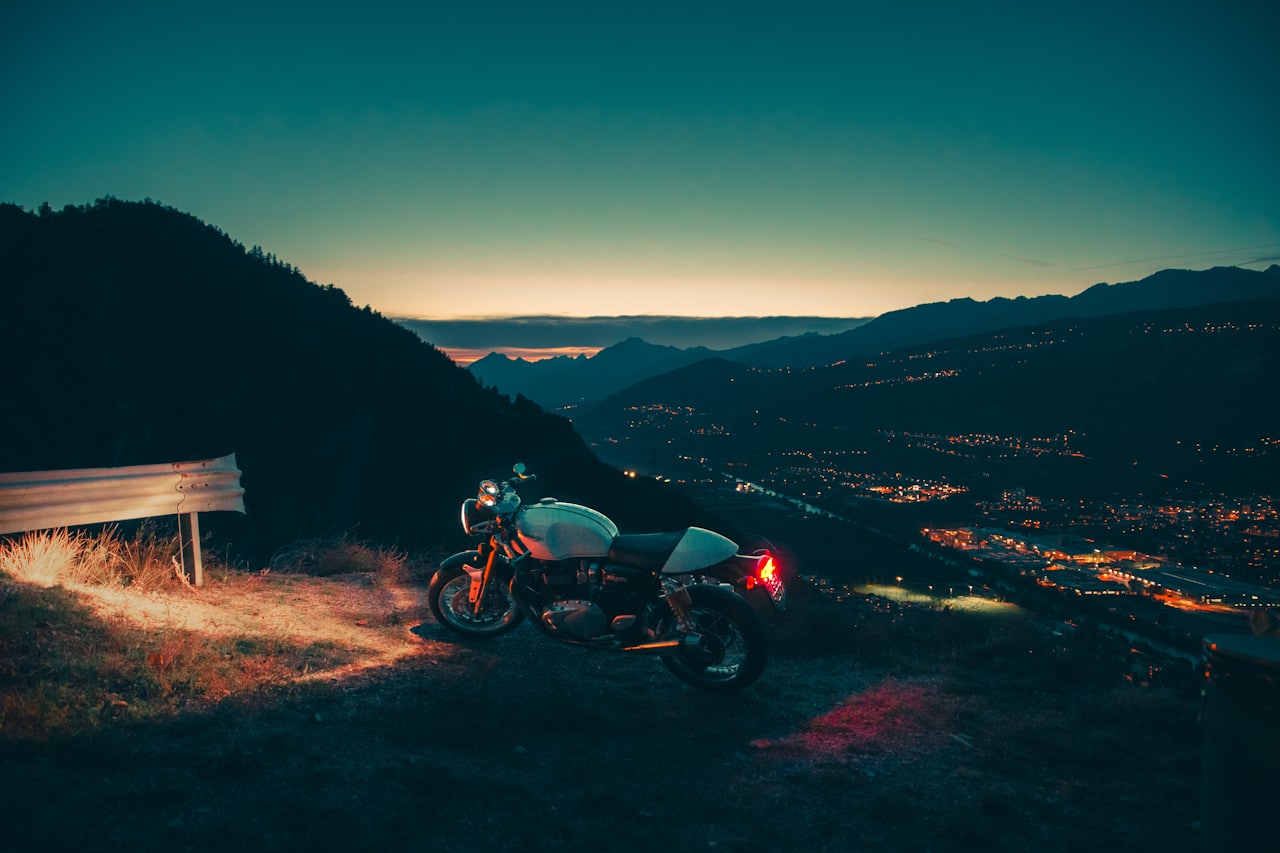
Every rider eventually reaches the same fork in the road: buy the machine engineered to erase distance, or buy the one engineered to ignore the road altogether. Heavyweight tourers like the Honda Gold Wing and BMW R1250RT are the first answer — rolling first-class cabins built to make a thousand-kilometre motorway day feel almost restful. Adventure-sport machines like the KTM 1290 Super Adventure S and Ducati DesertX are the second — tall, torque-heavy brutes that treat a rutted fire road as just another lane to devour.
I have swapped between both camps enough times to know the choice is rarely about which bike is better. Both categories cost broadly similar money, both will happily swallow a continent, and both will make you feel like the main character at every fuel stop. But they solve the problem of “big motorcycle” in almost opposite ways, and picking the wrong one is one of the more expensive mistakes a rider can make. This is a guide to the two philosophies, not a shootout between four specific models, so you can work out which one actually matches how — and where — you ride.
Two Very Different Answers to the Same Question
The heavyweight tourer’s entire design brief starts and ends with the rider’s comfort. Full fairings, deep adjustable screens and — on the Gold Wing — a seven-speed dual-clutch automatic gearbox with reverse all exist to strip friction out of covering ground. These are bikes built by engineers who assumed, correctly, that most owners spend the overwhelming majority of their mileage on smooth, sealed roads, often two-up, often for days at a time.
Adventure-sport bikes start from a different premise: that the destination might not have a proper road leading to it. Long-travel suspension, spoked wheels sized for genuine off-road rubber, and a chassis built to be stood on rather than sat in take priority, with touring comfort added as a welcome bonus rather than the founding principle. The DesertX’s 250mm of ground clearance and 21-inch front wheel exist for reasons the Gold Wing’s designers never had to think about.
Comfort on the Motorway: The Long, Straight Truth
Motorway comfort is where the heavyweight tourer simply does not lose. The Gold Wing’s 1833cc flat-six and the R1250RT’s 1254cc ShiftCam boxer both deliver huge, unhurried torque with almost no vibration transmitted to the rider, and both carry a fairing and screen engineered specifically to kill buffeting at sustained highway speed. Ride either one for six hours and you arrive refreshed rather than wrung out — that is the entire point of the exercise, and both machines nail it.
The adventure-sport pair can still cover big miles, but the experience is noticeably rawer. The KTM’s 1301cc V-twin and the Ducati’s 937cc Testastretta twin both have real character, and the KTM in particular offers genuinely strong radar-based adaptive cruise, but the taller, more upright stance catches more wind, the seats are firmer, and both engines transmit more of themselves through the bars and pegs. It is not unpleasant — some riders actively prefer feeling connected to the road — but it is a different species of comfort to the tourers’ isolation-tank plushness.
Weight tells the rest of the story at a standstill and in slow traffic. The Gold Wing’s 383kg and the R1250RT’s 279kg both demand respect at parking speed, and neither is a bike you casually muscle around a tight car park. The KTM at 249kg and the DesertX at 223kg are lighter and noticeably easier to paddle, filter and park, even though both still feel substantial once you are aboard and rolling.
Off the Tarmac and Down a Back Road
Take either heavyweight tourer off sealed tarmac and the conversation ends quickly. Cast wheels, road-biased tyres and modest ground clearance — 130mm on the Gold Wing, 145mm on the R1250RT — mean a gravel car park is about as adventurous as either bike is designed to get. These are exceptional machines on the surface they were built for, and honest about the surface they were not.
The KTM and the Ducati exist precisely to answer that gap. Spoked wheels, a 21-inch front hoop on the DesertX, 220mm to 250mm of ground clearance and long-travel WP or KYB suspension mean genuine gravel, hard-packed trail and washboard back road are all within reach, not just in the brochure but in reality. Dedicated off-road ride modes and adjustable traction control — and, on the DesertX, a chassis clearly influenced by rally-raid machinery — back that promise up with real substance.
It is worth being honest, though, that neither the Super Adventure S nor the DesertX is a lightweight enduro bike in disguise. At 249kg and 223kg respectively, both still ask for genuine skill and upper-body strength once the surface turns loose, steep or rutted, and they are no substitute for a proper dual-sport if serious trail riding is the actual goal rather than the occasional gravel detour. On a twisting, well-surfaced back road the picture flips again: the R1250RT’s Telelever front end and genuinely sporty chassis heritage let it carry real pace through sweepers despite its bulk, while the adventure-sport pair’s taller centre of gravity trades a little of that tarmac precision for the ability to shrug off a mid-corner pothole that would have a tourer’s rider gritting their teeth.
Luggage and Pillion Life: Living With It Day to Day
Pillion accommodation is arguably where the gap between these two categories is widest. The Gold Wing remains close to the best two-up motorcycle sold anywhere: a proper backrest, generous legroom and available heated seating front and rear turn a passenger into a genuinely happy passenger rather than a tolerant one. The R1250RT follows the same script with slightly less overall bulk but the same underlying philosophy — the pillion matters just as much as the rider.
Adventure-sport machines treat a passenger as a capability rather than a design pillar. Both the KTM and the Ducati can carry one, and both offer accessory seats and grab rails, but the narrower perch, taller reach to the pegs and reduced wind protection make a long two-up motorway stint noticeably less comfortable than on either tourer. If your riding regularly involves a partner and a proper touring itinerary, this single factor may decide the whole argument on its own.
- Integrated, weatherproof panniers and top box come standard on the heavyweight tourers; adventure-sport luggage is usually a well-designed aftermarket add-on
- A genuine two-up cockpit — backrest, armrests, heated seating options — on the Gold Wing and R1250RT that neither adventure-sport bike attempts to match
- Real off-road capability, spoked wheels and serious ground clearance on the KTM and DesertX that neither tourer can safely access
- A commanding, stand-and-see-over-traffic seating position and genuine filtering agility that only the adventure-sport pair can offer
- Strong adaptive cruise control now available across both categories, closing what used to be a clear touring-only advantage
Which Rider Actually Buys Which
The heavyweight tourer suits the rider whose year is built around long, mapped-out motorway trips, often two-up, who values plush comfort and minimal physical effort over versatility — the Gold Wing’s DCT automatic gearbox in particular removes the last bit of mechanical fuss from the equation. This is the rider who wants the destination to matter more than the journey’s texture, and who has the garage space and budget for a bike that rewards patience rather than adrenaline.
The adventure-sport buyer wants breadth. They may tour, but they also want the option of a gravel detour, a green lane, or simply a more commanding view over traffic on the daily commute. They are usually willing to trade some of the tourer’s plushness and pillion luxury for a bike that can genuinely do more things, even if it does each of them slightly less lavishly than a dedicated specialist would.
Ask around any car park after a track day and eventually you’ll hear the story: a rider grabs a handful of front brake mid-corner, the ABS pulses, the bike stands up, and suddenly they’re heading for the hedge instead of the apex. The conclusion is always the same — the ABS did this to me. It’s a story that spreads fast, gathers detail with every retelling, and is almost always wrong in the one place that actually matters: the part where ABS gets blamed for a crash it was actively trying to prevent.
So let’s ask the provocative question properly, out loud, and then answer it honestly. Is your motorbike’s ABS trying to kill you? No. It categorically is not. What follows is why — how modern cornering ABS actually works, why the real-world picture points overwhelmingly in its favour, and the small handful of genuine edge cases where it can catch an unprepared rider off guard. Understand those edge cases and you stop fighting the system that is, by any honest measure, one of the best things ever bolted to a motorcycle.
How Cornering ABS Actually Works
Traditional ABS only ever asked one question: is a wheel about to lock? It compared wheel speed against expected road speed and released brake pressure the instant a lockup looked imminent, and it did this on the assumption that the bike was upright. Cornering ABS, now fitted as standard on almost every mid-size and large motorcycle sold new, asks a far smarter question, because it has a great deal more information to work with. A six-axis inertial measurement unit — the IMU — tracks lean angle, roll rate, pitch and yaw many times a second, feeding that data to the ECU alongside wheel speed and brake pressure.
With lean angle in the equation, the system can estimate the tyre grip genuinely on offer at that specific angle, rather than assuming you’re sat bolt upright with the full contact patch available. Lean the bike over and there is simply less rubber and less vertical load resisting a locked wheel, so the system tightens its tolerances and steps in earlier and more gently than it would during upright, walking-pace braking. That is precision, not panic — the electronics are quietly recalculating your traction budget dozens of times a second and only ever spending what is actually there.
Crucially, cornering ABS does not merely stop a wheel locking. Many systems also manage lean-angle-dependent brake distribution between front and rear, and the best of them work hand in hand with lean-sensitive traction control to keep the whole chassis settled under simultaneous braking and turning loads — a job no human nervous system can do at the speed the electronics operate.
The Real-World Record: Fewer Crashes, Not More
Strip away the anecdotes and the wider picture is remarkably consistent: insurers, safety researchers and manufacturers who track long-term claims data all point the same direction. Motorcycles fitted with ABS are involved in meaningfully fewer crashes than otherwise comparable non-ABS machines, and the gap is widest in precisely the scenario riders fear most — an emergency stop that goes wrong. The reason is unglamorous but decisive: most riders, under genuine panic, brake later and harder than they believe they do, and a locked front wheel at that moment ends in a low-side almost every single time. ABS simply removes that one specific failure mode from the equation, quietly and repeatedly.
None of which means ABS makes crashes impossible, and no honest reviewer would claim otherwise. It cannot manufacture grip that genuinely isn’t there — sheet ice, a diesel spill or a wheel already airborne over a mid-corner bump are still beyond anything a computer can fix. What it reliably does is convert the single most common cause of a braking crash — an unintended front-wheel lockup — into a complete non-event, over and over, for riders who would otherwise never have felt it coming.
Where ABS Genuinely Surprises Riders
The myth doesn’t come from nowhere, though, and being straight about where cornering ABS genuinely feels strange is the whole point of this piece. Loose gravel and hard-packed dirt are the biggest offender. ABS calibration is built around a wheel-speed model that assumes a reasonably consistent, high-friction surface; on loose stones that assumption breaks down constantly, because wheel speed naturally fluctuates as small stones roll and shift beneath the tyre. The system can misread that fluctuation as an impending lockup and release brake pressure right when you wanted maximum retardation, extending your stopping distance rather than shortening it. It’s exactly why serious adventure bikes ship with a switchable, reduced-intervention off-road ABS mode — and why leaving it in road mode on a gravel track is asking for trouble.
Mid-corner trail braking is the second genuine edge case, and it tends to catch sportier riders rather than novices. Trail braking deep into a bend — carrying a trace of front brake well past turn-in — is a legitimate, widely taught technique, but it asks the system to make its lockup calculation at the exact moment lean angle, load transfer and available grip are all shifting simultaneously. Push that combination right to the edge of what the tyre can actually give, particularly on cold rubber or a greasy patch, and cornering ABS will intervene to protect the front. That intervention — a firm pulse through the lever while you’re leaned right over — can feel abrupt to a rider who wasn’t expecting it, even though the system is doing precisely what it was designed to do.
A third, smaller surprise crops up when riders swap between bikes: a rear wheel lifting slightly under very hard front braking, or an unfamiliar amount of lever pulsing compared with whatever they rode last. Neither is a fault. It’s simply a different calibration philosophy, and the fix is familiarity with your own machine, not distrust of the technology fitted to it.
Cornering ABS has never once tried to kill me — but on at least two occasions, it has very obviously stopped me killing myself.— Hana Kobayashi, Features Writer
Riding With ABS Instead Of Fighting It
The riders who get the most out of modern ABS are the ones who stop treating it as a rival fighting their inputs and start treating it as a grip calculator working on their behalf. That means braking with real intent rather than hesitation: squeeze the lever progressively and with genuine commitment in a true emergency, because the system is built to be leaned on hard, not feathered nervously. Trust the pulse when it arrives — it is information, not malfunction — and resist the urge to snap the lever shut the instant you feel it, because that instinct defeats the entire point of the system.
It also means respecting the two edge cases above rather than resenting them. Switch to a gravel or off-road ABS mode before the tarmac runs out, not after you’ve already lost the front on loose stones. And if trail braking deep into corners is part of your riding, build that habit gradually on familiar roads or a track day first, and accept that an intervention there is the electronics catching a margin you had already spent — not a machine deciding to work against you.
- Learn where your bike’s ABS modes live and switch to gravel or off-road mode before the surface changes, not after.
- Squeeze the front brake progressively and with real commitment in an emergency — ABS rewards decisive input, not hesitation.
- If you trail brake, build the technique gradually on familiar roads or a track day before pushing it near the limit.
- A firm pulse at the lever mid-corner is the system working, not failing — don’t snatch the lever shut in response.
- Spend five minutes in an empty car park learning exactly how your specific bike’s ABS feels before you ever need it for real.
- Only disable ABS if your bike offers it as a deliberate, understood option — never out of a vague sense that it’s “in the way”.
Verdict
Your motorbike’s ABS is not trying to kill you. On the balance of overwhelming real-world evidence, it is one of the most quietly effective pieces of engineering ever fitted to a motorcycle — a system that has converted countless would-be low-sides into uneventful, forgettable stops, most of which the rider involved never even registered as a near miss.
The edge cases are real, but they are narrow, well understood and entirely manageable: respect loose surfaces, build your trail-braking technique deliberately, and treat every pulse at the lever as useful information rather than betrayal. Learn those few rules and cornering ABS stops feeling like an unpredictable passenger on your motorcycle, and starts feeling like exactly what it is — the best safety net riding has ever built in.
Buying your first motorcycle is one of the great rites of passage in a rider’s life, and it should feel exciting. It can also feel overwhelming, because the choice you make shapes how quickly you build confidence, how much you spend and whether the whole adventure sticks. Get it right and the bike becomes a trusted teacher; get it wrong and it becomes an expensive ornament gathering dust in the corner of the garage.
The good news is that choosing well is mostly about honesty and patience rather than horsepower. This guide walks you through every stage — understanding your own needs, matching a category to your riding, weighing new against used, setting a realistic budget and inspecting a machine before any money changes hands. Take your time here and the reward is a bike you will actually enjoy learning on.
Start With an Honest Self-Assessment
Before you look at a single listing, take stock of who you are as a rider. How tall are you, and can you get the balls of both feet down comfortably at a stop? What is your typical journey — city gridlock, open motorway, or twisting back roads? How much genuine seat time do you have? New riders almost always overestimate the machine they can handle. A bike you feel relaxed on will be ridden often and mastered quickly, while an intimidating one quietly stays parked and teaches you nothing.
Licensing rules also shape your options, and they vary from country to country. Many regions operate tiered systems — such as Europe’s A1, A2 and full A licences — that cap the power a newer rider may use, and insurers frequently reward smaller-capacity machines with far lower premiums. Check exactly what you are legally entitled to ride before you fall for something you cannot yet licence or afford to insure, and treat any restriction as a helpful stepping stone rather than a frustrating limitation.
Match the Category to Your Riding
Motorcycles come in families, and each rewards a different life. For most beginners a standard or naked bike in the 300 to 500cc bracket hits the sweet spot: upright ergonomics, gentle power delivery, low weight and forgiving manners. Small adventure bikes and modern classics make superb all-rounders too. What you should avoid on day one is a litre-class supersport, which serves race-track power with no patience for mistakes.
- Standard and naked bikes — the classic first choice for their upright seating and easy manners.
- Small adventure bikes — tall, comfortable and happy on rough surfaces; the Royal Enfield Himalayan 450 is a friendly example.
- Modern classics and retros — approachable power, timeless looks and usually a low, reassuring seat.
- Small cruisers — relaxed and confidence-inspiring, though less rewarding on truly twisty roads.
- Leave full-power supersport and litre bikes until you have a season or two behind you.
New or Used: The First-Bike Question
There is a strong case for buying used as your first machine. Beginners drop bikes — in car parks, at junctions and while learning slow-speed control — and a scuffed second-hand bike hurts far less than a scratched showroom model. Used bikes also shed the steepest depreciation before you ever own them. A new bike, by contrast, brings a warranty, a known history, finance options and the reassurance that nothing has been abused. If money is tight, a well-kept used bike frees up cash for quality protective gear, which matters more.