Kawasaki doesn’t do sport-tourers by half measures, and the 2026 Ninja 1000SX proves it again without reinventing anything that didn’t need reinventing. This is a bike built for riders who want three hundred road miles in a day and a genuine sense of speed once the motorway ends, and for 2026 Kawasaki has sharpened exactly the parts of the package that mattered instead of chasing a redesign for its own sake.
That’s the headline, really: this isn’t a ground-up rethink. It’s a mature, fast, comfortable machine getting the electronics and finishing touches that keep it relevant against a field of rivals that have all gotten more expensive, more complicated, and in some cases more compromised. The 1043cc inline-four is still doing the heavy lifting, and it’s still one of the most satisfying engines in the class.
What's Actually New for 2026
The changes for 2026 are evolutionary rather than revolutionary, and that’s the right call for a bike that was already close to sorted. Kawasaki has refined the electronics suite — the IMU-based platform still underpins cornering ABS and traction control, but the calibration feels smoother at the margins, less like a system stepping in and more like it was never needed in the first place. The quickshifter remains standard fitment, and it’s still one of the slicker units in the class in both directions.
The TFT dash and Kawasaki’s Rideology smartphone connectivity carry over largely unchanged, which is fine — they already worked well enough. Where you’ll actually notice a difference is in small aerodynamic tweaks around the screen and fairing, aimed at cutting the buffeting that annoyed taller riders on earlier versions, plus a fresh set of colourways that lean into the SX’s sporting identity rather than pretending it’s an adventure bike in a two-piece suit.
None of this is flashy news. There’s no new engine, no radical chassis rework, no semi-active suspension arriving to justify a price hike. That restraint is arguably the smartest thing about the 2026 update: Kawasaki knows exactly what this bike is for, and it hasn’t tried to turn it into something else.
Sport-Tourer, Not Adventure-Tourer, Not Full Dresser
The sport-touring middle ground has gotten crowded and confused. Adventure-styled machines like Kawasaki’s own Versys 1000 borrow the same engine and try to do everything at once, while bikes like the BMW R1250RT lean fully into touring comfort at the cost of any real sporting intent. The Ninja 1000SX sits deliberately in between, and that positioning is the entire point of the bike.
It doesn’t have the wind protection of a full tourer, and it doesn’t want it. What it offers instead is a proper sportbike riding position softened just enough for a long day, a fairing that actually manages air rather than just looking sporty, and a chassis that will happily follow something far more exotic through a set of corners it has no business keeping up with. Set it against something like the Ducati Multistrada V4 and the difference in character — and in price — is stark.
This is also not a bike for riders chasing outright drama. If you want a hyper-sport experience, look elsewhere. The 1000SX’s whole appeal is that it’s quick without being intimidating, comfortable without being soft, and capable of covering serious distance without ever feeling like you’re piloting something the size of a Honda Gold Wing.
On the Road: The Bit That Actually Matters
Numbers on a spec sheet don’t tell you what a bike feels like at 7,000rpm with a full tank and 200 miles still to go, and that’s where the 1000SX earns its reputation. The inline-four pulls hard and cleanly from low in the revs, with none of the flat spots that plague some torque-focused sport-tourers, and it still has enough top-end urgency to make an overtake feel genuinely satisfying rather than merely adequate.
The riding position rewards a long stint better than most bikes wearing this much fairing plastic. Wrists carry a fair chunk of weight at low speed, as you’d expect from something with sporting DNA, but that weight disappears once you’re moving and the aero is doing its job. The seat is the one component that starts reminding you of the miles after a few hours — it’s fine, not outstanding, and riders planning genuinely long tours would be sensible to budget for an aftermarket perch.
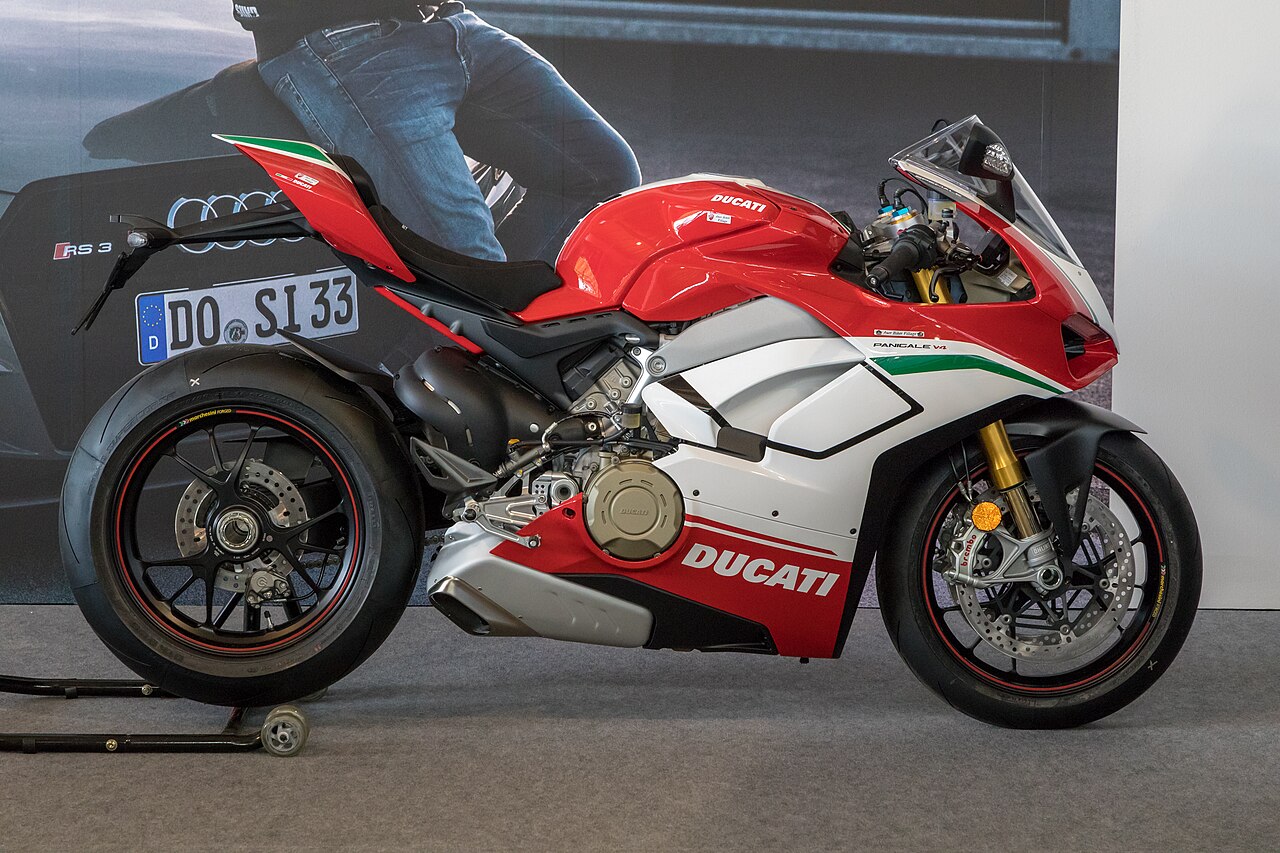
There are fast motorcycles, and then there is the Panigale V4 — a machine that behaves less like a road bike wearing a number plate and more like a Desmosedici GP racer that took a wrong turn out of the pit lane. Thumb the starter and the 1103 cc V4 settles into a lumpy, uneven idle, a deliberate reminder that Ducati borrowed this engine’s counter-rotating crankshaft and firing order straight from the Grand Prix paddock.
For 2025 the Panigale has been honed rather than reinvented, and the result is the most complete superbike Borgo Panigale has ever built. It flatters the quick, forgives the brave, and never once lets you forget that its natural habitat is a circuit with run-off measured in acres rather than metres. Ride it gently and it simmers; open it up and it detonates.
An engine ripped from the Grand Prix grid
The Desmosedici Stradale is the undisputed star. Ninety degrees of liquid-cooled V4 fury spins hard towards 14,000 rpm and serves a claimed 214 hp, arriving with a top-end rush that seems to compress the horizon towards you. Below 8,000 rpm the motor is tractable, almost civil; beyond that the counter-rotating crankshaft and desmodromic valvetrain conspire to hurl you forward with a violence few road vehicles on earth can match.
The headline figures tell only part of the story — 2.9 seconds to 100 km/h and a top speed brushing 300 km/h — because it is the delivery that truly lingers in the memory. The V4 howls where a Japanese inline-four merely screams, a hard-edged bark that turns every underpass into a private concert hall. The up-and-down quickshifter is close to telepathic, and the ride-by-wire throttle stays precise enough to trust at full lean.
Every few months some pub car park debate reopens the oldest argument in biking: which engine configuration is actually best? The trouble is that almost every answer you’ll find has been imported wholesale from somewhere else entirely — a track day in Spain, a keyboard warrior’s autobahn fantasy, a spec sheet drawn up for a country with wide, dry, arrow-straight roads. None of that has much to do with what most of us actually ride on. British roads are narrow, damp more often than not, stitched together from third-gear corners, and rarely let you hold a throttle open for more than a few seconds before the next roundabout, tractor or blind crest arrives. Judged against that reality rather than a fantasy one, the debate has a clear answer — and it is not the one the horsepower charts want you to believe.
I have ridden every configuration on this list on the same roads, in the same weather, in the same commuting traffic that most owners actually face day to day — not on a circuit, and not on a sun-baked press launch, but on the A- and B-roads of England, Wales and Scotland, where average speed rarely climbs much past 40mph and second gear gets more use than fifth. Run that test honestly and it produces a genuine winner. Let me walk you through why.
What UK Roads Actually Ask of an Engine
Before crowning anything, it is worth being honest about what British riding actually demands, because it is almost nothing like the conditions most engines are designed and marketed around. Our roads change direction constantly, so an engine needs usable drive from low revs rather than a glorious top end you’ll sample twice a year on a derestricted dual carriageway. Grip is inconsistent and frequently poor — wet tarmac, diesel spill, mossy hedgerow shade — so how an engine delivers its power at part-throttle matters more than how much it makes at full throttle. And because junctions, roundabouts and blind bends arrive every few hundred yards, you are changing gear constantly, which punishes anything with a narrow, fussy powerband or a slow, deliberate gearbox action.
None of this shows up on a spec sheet. A dyno chart tells you nothing about how an engine behaves at 30mph in third gear, in the rain, downhill, into a blind right-hander — which is, if we’re honest, close to ninety percent of real British riding. So that is the test I’m applying here, not top speed, not a quarter-mile time, not lap-record potential. Just the everyday reality of riding a motorcycle in this country.
The Inline-Four: Magnificent, and Mostly Wasted
There is no configuration more thoroughly vindicated by a racetrack than the inline-four. Smooth, powerful, endlessly tuneable, and capable of the kind of top-end fireworks that make naked fours like the Kawasaki Z900 so intoxicating on paper. The problem is that almost none of that fireworks display is usable, or even legal, on the road you actually ride to work on. Peak power on a typical inline-four arrives somewhere north of 9,000rpm, a figure you will visit rarely, briefly, and usually somewhere you probably shouldn’t.
On a tight, damp B-road, an inline-four spends most of its life below the point where it actually gets interesting. You end up working a taller, closer-ratio gearbox constantly just to keep the engine near its comparatively narrow sweet spot, and if you don’t keep it spinning, the bike can feel oddly flat and characterless at the pace UK roads actually allow. It is a phenomenal engine wearing the wrong job description — brilliant for a track day or a derestricted continental blast, frequently frustrating on the lane behind your house.
The V-Twin: Glorious Character, Awkward Fit
A good V-twin is one of the great sensory experiences in motorcycling: the lazy thump, the huge low-down torque, the sense the engine is doing real, visible work rather than merely spinning fast. The Ducati DesertX proves the layout can still be genuinely capable when it’s engineered right, with enough midrange shove to make gear-changing feel almost optional through a set of flowing bends.
But the layout brings baggage that UK roads expose ruthlessly. Many V-twins, especially the heavier, cruiser-styled machines, carry their weight low and wide, which is wonderful for stability on a motorway and considerably less wonderful when you need to flick the bike through a sequence of opposing bends on a road that changes direction every few seconds. The classic V-twin power delivery — a hefty, almost binary thump rather than a smooth build — also asks more of your right wrist in the wet, where a clumsy input is punished immediately by a rear tyre with limited grip in reserve. It’s a magnificent engine for a straight road or a gentle sweeper. It is harder work on the roads most of us actually ride.
The Parallel Twin: The Honest Workhorse
This is where the argument starts to sharpen. A modern parallel twin, especially one with a 270-degree crank, borrows much of the V-twin’s low-down character — that same accessible, unintimidating shove from low revs — while shedding a good chunk of its weight and width. Bikes like the Yamaha MT-07 have built an entire reputation on exactly this trick: an engine that pulls cleanly from little more than idle, a chassis light enough to change direction without effort, and a gearbox you barely need to trouble because there’s usable drive almost everywhere.
For town riding, commuting, and the kind of low-speed, stop-start, damp-morning riding that makes up most UK journeys, the parallel twin is genuinely hard to beat. It’s forgiving in the wet, unintimidating for less experienced riders, and cheap to buy, insure and maintain. Its only real limitation is character and reach: push toward the upper end of a parallel twin’s rev range and things can turn a little flat or vibratory, and there simply isn’t the extra layer of top-end drama that makes a bike feel special on the rare open, flowing road you do find. It is the most sensible answer here. It is not quite the most complete one.
The Inline Triple: The One That Actually Fits
Which brings us to the configuration I think the British riding environment has been quietly rewarding for two decades: the inline triple. Machines like the Triumph Street Triple 765 RS, the Yamaha MT-09, and the more affordable Triumph Trident 660 all share a trait that matters enormously on the roads we’ve been describing — a genuinely broad, tractable spread of torque from low revs that never runs out of ideas as the tacho climbs, right up into a top end with real character and pull.
That combination means a triple rarely leaves you hunting for the right gear on a tight lane, because there usually isn’t a wrong one. Trickle out of a village at low revs and there’s enough drive not to need a downshift; open the road out for a moment and the same engine finds another, more urgent gear of its own accord, without you doing anything except opening the throttle further. It is lighter and narrower than almost any V-twin, so it changes direction through a sequence of opposing bends with none of the heft a cruiser-style engine imposes on the chassis around it. And its power delivery is smoother and more linear than a V-twin’s thump, which matters enormously the moment the road turns damp and grip becomes something to manage rather than assume.
It is also, not coincidentally, the layout behind some of the most road-focused, UK-tuned motorcycles currently on sale — the kind of bikes shaped by engineers who test on the same wet Welsh mountain roads the rest of us actually ride, rather than a sun-baked circuit. That is not an accident. It is an engine configuration built, whether by design or happy coincidence, for exactly the roads most of us own a bike to ride.
- Torque figure and where it peaks: a number below 6,500rpm matters more here than a big peak power figure.
- Kerb weight, because a light bike forgives more of every mistake a damp B-road will eventually ask of you.
- Gearing: tall, motorway-biased gearing can blunt an otherwise flexible engine’s usefulness on tighter roads.
- Throttle response at low, partial openings — this is where wet-weather confidence actually lives.
- How the bike behaves in second and third gear, not sixth, because that is where you will spend most of your riding life.
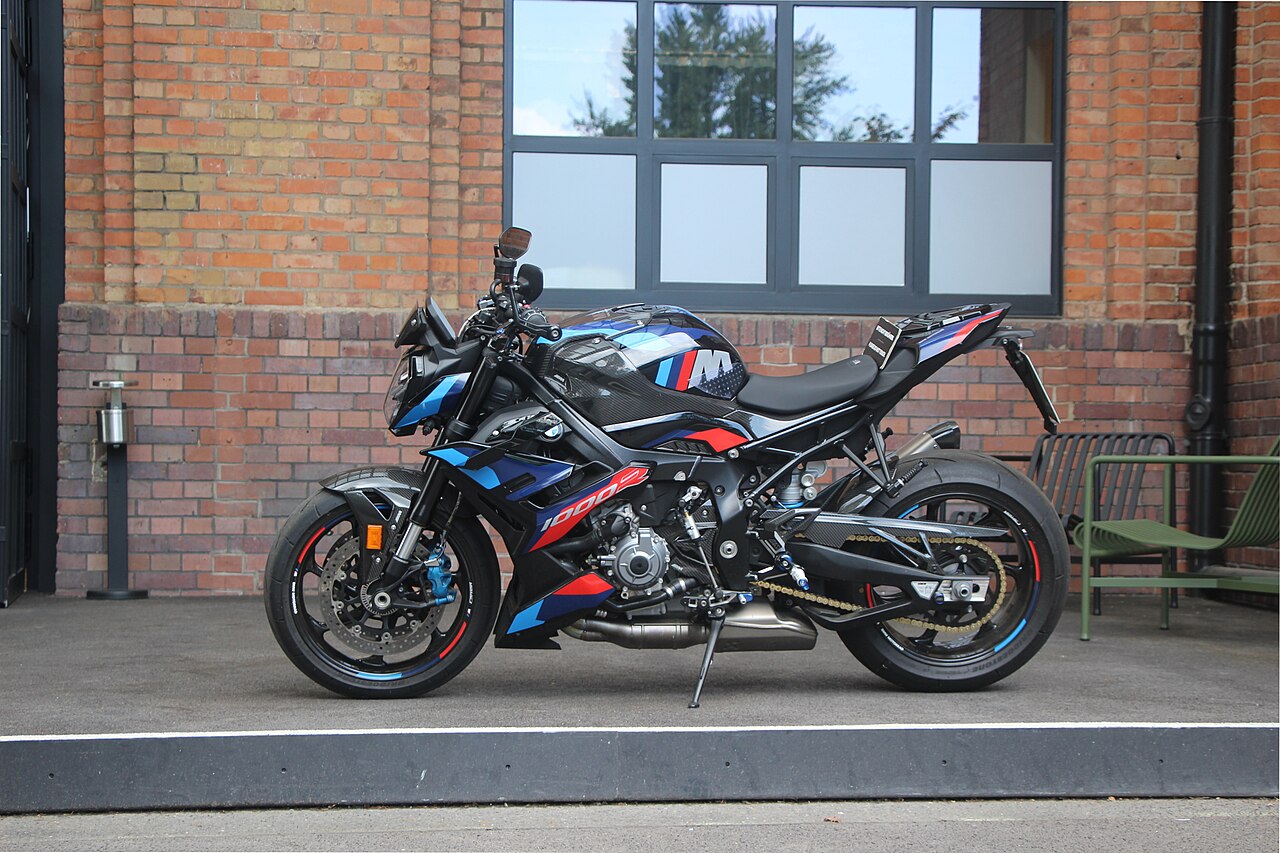
The M badge means something specific in Munich. On four wheels it signals a car engineered to devour a racetrack yet still cruise home in comfort, and the M 1000 RR carries that same philosophy onto two. This is not merely a hotted-up S 1000 RR; it is a homologation special, built so BMW’s factory riders have a weapon worthy of World Superbike, then handed to us with lights and mirrors bolted on.
Where the Ducati seduces with operatic theatre, the BMW conquers with cold, ruthless efficiency. It is the fastest-accelerating, highest-topping superbike in this test, and it feels engineered by people who treat every tenth of a second as a personal insult. On the right stretch of derestricted autobahn, nothing here comes close.
ShiftCam power without the peaks and valleys
The 999 cc inline-four is the headline act. BMW’s ShiftCam variable valve timing hands the M a genuinely broad spread of torque, so the 212 hp peak at 14,500 rpm never feels like a distant reward. There is meaningful drive from 6,000 rpm, a surging midrange, and then a top-end crescendo that pins your visor to the screen and refuses to let go until the limiter chimes.
The numbers are frankly absurd for a road-legal machine: 3.0 seconds to 100 km/h and a genuine 306 km/h maximum. Yet the delivery is so linear, so utterly predictable, that it flatters rather than frightens. The M quickshifter snaps through the six-speed box with mechanical crispness, and the induction howl at full chat is one of motorcycling’s great sensory rewards.
Ask a certain type of rider about CFMoto and you will get the same three words back before you have even finished the sentence: cheap, Chinese, unreliable. It is a reflexive judgement, delivered with total confidence by people who have often never ridden one, and it has not updated itself since roughly 2015. I understand where it comes from — the brand’s earliest Western-market bikes gave people real reasons to worry, and reputations in this industry are stubborn things that outlive the products that earned them by a decade or more. But holding that opinion in 2026 requires ignoring almost everything the company has actually done since.
I have spent enough hours on CFMoto’s current-generation machines, and enough hours reading what the owners who actually live with them have to say, to think the reliability conversation deserves a rewrite. Not a hagiography. Not a pretence that the brand has become indistinguishable from Honda overnight. Just an honest look at what has genuinely changed, what has not, and why the old assumption is doing CFMoto a disservice it no longer deserves.
Where the Reputation Came From
It is worth being fair about the origin of the skepticism, because it was not invented out of nowhere. CFMoto’s first wave into Western markets arrived while the company was still finding its feet as a manufacturer rather than a components supplier, and some of those early machines had the rough edges you would expect from any brand rushing up the learning curve — inconsistent finishing, electrical gremlins, switchgear that felt like an afterthought. Riders who bought in during that era and got burned had every right to their opinion, and word of mouth from a bad experience travels a lot further than word of mouth from a good one.
The problem is that that CFMoto and the CFMoto building bikes today are barely the same company. Judging a current 450SS or 700CL-X on the reputation earned by a decade-old scooter is a bit like refusing to fly a modern airliner because of something that once went wrong with a biplane. Somewhere in the last several years the manufacturing quality quietly caught up with the ambition, and almost nobody who was not paying close attention noticed it happen.
The KTM Connection Changed the Calculus
The single biggest reason to reconsider CFMoto’s reliability is not marketing — it is who they have been building engines alongside. CFMoto has spent years as a genuine manufacturing partner to KTM, co-engineering and producing engine architecture used across KTM’s own mid-size Duke and Adventure models for global markets. That is not a badge-engineering arrangement or a cosmetic licensing deal; it means CFMoto’s factories are held to the tolerances and quality processes that a demanding, reliability-conscious Austrian manufacturer is willing to put its own name on.
You do not hand a supposedly unreliable manufacturer the job of building engines that will wear your logo on the tank. KTM’s engineers spent real time inside CFMoto’s plants, and that scrutiny left fingerprints on CFMoto’s own product line too — sharper tolerances, tighter quality control on the line, a more disciplined approach to sourcing components. The company that emerged from that partnership builds noticeably tighter machines than the one that existed before it, and you can feel that difference in the fit and finish the moment you sit on something like the 450SS or the 700CL-X.
It Is Not Just KTM
The KTM relationship gets all the attention because it is the easiest story to tell, but treating it as the sole explanation undersells how much CFMoto has grown on its own terms. This is a manufacturer that has ploughed serious money into its own research and development, expanded its engineering headcount, and moved from copying silhouettes to designing genuinely original chassis and engine layouts across a widening model range. The 700cc parallel-twin platform underpinning several of its current bikes was not handed down from a partner; it was developed in-house, and it rides like it.
That kind of investment does not happen at a company content to stay cheap and disposable. Building your own engine platforms, expanding a global dealer footprint, and chasing homologation in markets with strict emissions and safety standards is expensive, unglamorous work that only makes sense if you are planning to still be here in twenty years. CFMoto is clearly planning on it, and reliability is the natural byproduct of a company building for the long game rather than a quick sale.
What the Warranty Tells You
Manufacturers rarely say the quiet part out loud, but their warranty terms do the talking for them. A company that privately doubts its own build quality prices its cover short, hedges its exposure, and hopes the bike survives long enough that most owners never claim. CFMoto has instead pushed its standard coverage in North America out to a length that sits comfortably alongside, and in some cases beyond, what the mainstream Japanese brands offer as standard. That is not the behaviour of a manufacturer that quietly expects its bikes to fall apart.
For the better part of a decade, asking which naked bike offers the best value in Britain has had a boring, one-word answer: Yamaha’s MT-07. It arrived in 2014 as a bit of a happy accident, a cheap parallel-twin wrapped in an unglamorous steel frame, and somehow became the default entry on almost every learner’s, commuter’s and downsizer’s shortlist. That is a remarkable run for any motorcycle to sustain, and reputations built that early tend to calcify into assumption rather than fact.
But assumption is exactly what I want to test here, because the naked-bike middleweight class in the UK has quietly become the most competitive corner of the entire market. Suzuki’s GSX-8S undercuts nothing and still manages to feel like the smarter buy on a spec sheet. Honda’s CB750 Hornet turned up with a genuinely thrilling engine and a badge that opens doors at resale. Kawasaki refreshed the Z650 rather than letting it fade quietly, and Triumph’s Trident 660 keeps sniping from the same price bracket with a triple that sounds better than anything else here. So does the MT-07 still deserve the crown, or has nostalgia been doing its marketing for it? I have ridden all of them back to back this year, and I have a clear answer.
The Rivals Have Actually Turned Up
Let’s give the competition its due, because for years the MT-07 barely had any. That is no longer true. The GSX-8S borrows a 776cc parallel twin from Suzuki’s own V-Strom, and it feels like a genuinely more sophisticated machine at a standstill: a proper TFT dash, a chassis that turns in with real precision, and a fit and finish that makes the Yamaha’s switchgear feel a generation older than it actually is. The Honda CB750 Hornet is sharper still. Its 755cc twin spins harder and more eagerly than either rival, and Honda has wrapped it in bodywork that looks like it costs more than it does. Kawasaki’s Z650, smaller in displacement but sharper than ever, undercuts everything here on price and remains a genuinely lovely, unintimidating first big bike. None of these are also-rans anymore. They are proper, considered motorcycles, and any one of them would make a perfectly sensible purchase.
This matters because the MT-07’s original pitch, that nothing else this cheap is this good, depended on a vacuum that no longer exists. The gap in outright competence has closed, and in a couple of isolated categories, like dash quality or braking feel, I think the newer bikes have actually nosed ahead. If this were purely a showroom beauty contest judged on spec sheets and first impressions, I am not sure the MT-07 wins anymore.
The Engine That Still Wins Arguments
Which is why the CP2 engine matters so much to this argument. Yamaha’s 689cc crossplane twin produces a relatively modest 73 hp, well down on the Hornet’s peak figure and a few horses shy of the GSX-8S, and on a spec sheet that looks like a weakness. Ride it, and it stops looking like one almost immediately. The 270-degree crank gives the motor an uneven, lumpy firing order that translates into real, chest-level torque from just above idle, with 67 Nm arriving at only 6,500 rpm, low enough that you rarely need to visit the upper half of the tacho at all. It pulls cleanly out of roundabouts in a gear too tall, shrugs off a pillion and a full tank, and never asks you to work for the fun the way a peakier engine sometimes does.
The Hornet’s engine is the more thrilling thing to rev out, and I will not pretend otherwise; it wants to be worked and rewards you when you do. But the MT-07’s motor is the one that is genuinely more usable on a wet Tuesday commute, and usability, not lap times, is what most owners are actually buying. There is also something the spec sheet cannot capture: character. The CP2 has a slightly agricultural, off-beat thump that makes even gentle riding feel eventful, and after eleven years on sale it remains one of the most likeable engines in motorcycling at any price, let alone this one.
Price Is Not the Whole Picture
On sticker price alone this class is closer than the reputations suggest; a few hundred pounds separates most of these bikes once you are actually stood in a UK dealership. But that is the wrong way to compare them, because the MT-07’s real advantage has never really been the RRP. It is everything that follows the purchase.
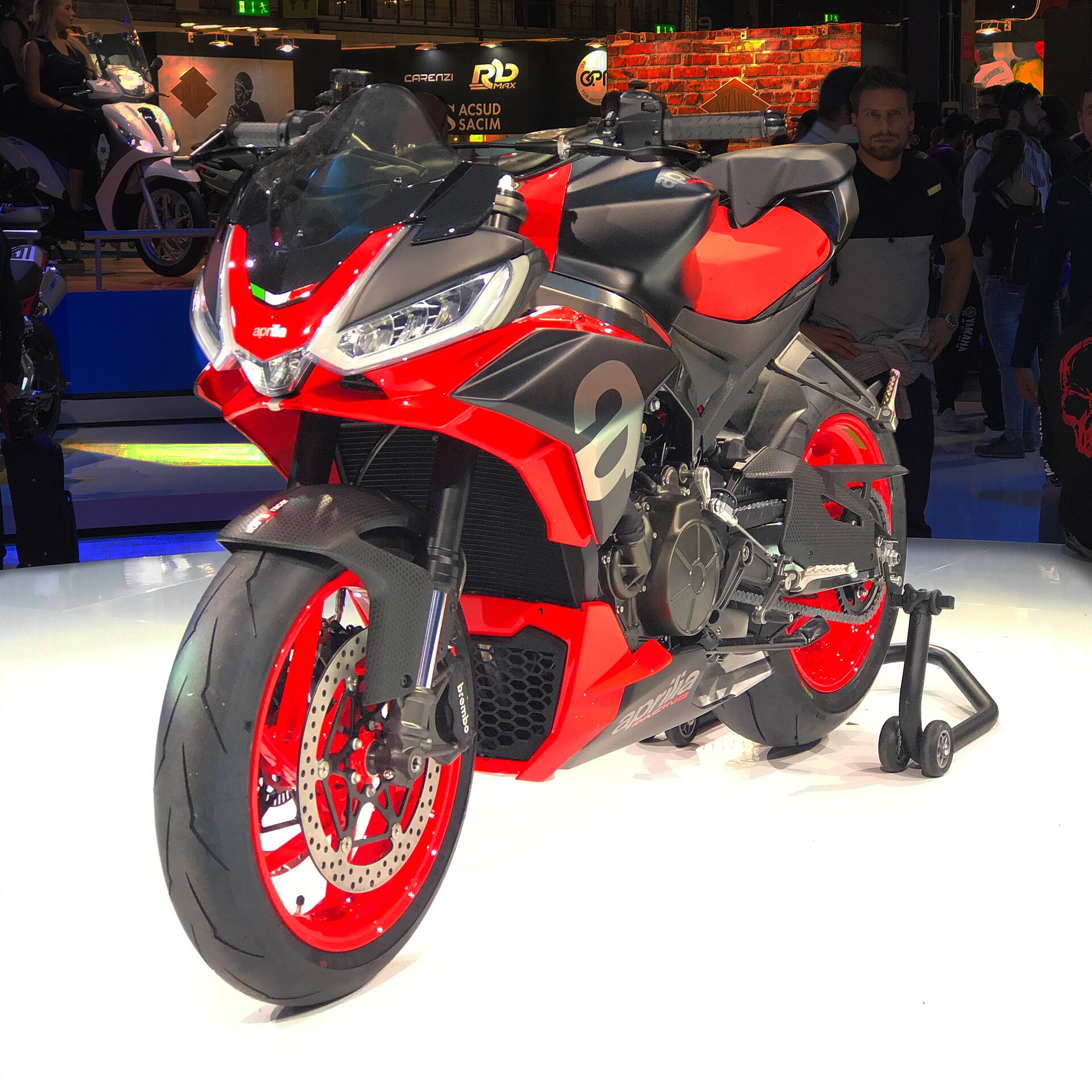
It is easy to be seduced by big numbers, but the Tuono 660 makes a compelling case that the most thrilling motorcycles are often the lightest. Aprilia took its RS 660 sportbike, raised the bars, sharpened the attitude and created a naked that trades brute force for a scalpel-like precision. On a real road, ridden hard, it delivers a purity of experience that far more powerful machines struggle to match.
This is a bike built by a company with racing in its blood, and it shows in every input. The Tuono 660 does not overwhelm you with power; it invites you to carry corner speed, to be smooth, to enjoy the process. Get it right and it flows down a ribbon of tarmac like almost nothing else at the price.
A twin with genuine character
The 659 cc parallel-twin, effectively the front bank of Aprilia’s V4 superbike engine, produces 95 hp at 10,500 rpm and a useful 67 Nm of torque. That may sound modest against triples and fours, but in a bike this light it is more than enough to thrill, and the 270-degree crank hands it a throaty, characterful bark that belies its middleweight displacement.
The delivery is the clever part. There is enough low-down drive to make it easy in town, a strong, elastic midrange that suits real-world roads perfectly, and a top-end that rewards a committed rider chasing the redline. It will dispatch 100 km/h in around 3.6 seconds and stretch to 220 km/h, but it is the everyday accessibility of that performance that makes it so addictive.
Two hundred and eight horsepower. No fairing. A handlebar instead of clip-ons, and a riding position that puts your chin roughly where a superbike rider’s chest would be. On paper, the Ducati Streetfighter V4 reads like a dare: take the beating heart of the Panigale, strip away the aerodynamics and the excuse for a full tuck, and hand the whole savage package to a rider sitting bolt upright with nothing to hide behind. I have now lived with one long enough to answer the only question that actually matters, which is not whether it’s fast, because obviously it is, but whether 208 hp in a naked bike is something a normal road rider should actually want to own.
The short answer is complicated, and anyone who tells you it’s simple either hasn’t paid for a desmo service or hasn’t sat in traffic in July with a 90-degree V4 idling between their knees. Every publication on earth has already told you what this bike can do on an empty mountain road at nine in the morning, and that story is true. This is the other story: what it’s actually like to own the thing, day after day, on the roads the rest of us actually ride.
Two Hundred Horsepower You Will Almost Never Use
Let’s deal with the headline figure first, because it’s the reason most buyers walk into the showroom. 208 hp at 12,750 rpm sounds like a number built for bragging rights, and mostly, it is. On the road, any road, in any country with a speed limit and other people on it, you will use perhaps the bottom third of that rev range for well over ninety percent of your riding. The other two-thirds exists for track days, for the one clear straight you find twice a year, and for the story you tell at the pub.
What you actually feel, hour after hour, is the mid-range shove: the way the Desmosedici Stradale hauls from 4,000 rpm with a violence that makes a 100-hp naked feel unfinished by comparison. That part of the case for this bike is real, and I won’t argue against it. Third-gear roll-ons out of roundabouts are genuinely intoxicating, and no lesser naked I’ve ridden replicates the sensation of this V4 loading up under your right wrist at half throttle. But the peak number on the spec sheet is bragging-rights power, not usable power, and pretending otherwise is how riders end up buying far more bike than their actual riding calls for. Ask yourself honestly how many times a year you’ll see an indicated 150 mph on a public road with your licence intact — if the answer is never, you are paying, in purchase price, in insurance, in every service invoice, for a top end you are buying purely to know it exists.
Living With a Desmodromic Heart
The Desmosedici Stradale is a mechanical masterpiece and also, by any sane measure, overkill for a bike that mostly does the school run. Ducati’s desmodromic valve system doesn’t use springs to close the valves; it uses a second set of cams to physically shut them, which is part of why this engine can spin so hard and so cleanly toward its redline. It’s also why it demands attention a Japanese inline-four simply doesn’t.
The valve-clearance check, the big and genuinely expensive one, where the tank comes off and a technician gets intimate with the cylinder heads, now falls at a 24,000 km (roughly 15,000-mile) interval on this generation of engine. That’s a real improvement on older desmo Ducatis, and the brand deserves credit for stretching it. But “improved” is relative. That single service, even on a generous interval, will cost meaningfully more than a whole year of running something like a Z900 or an MT-09, and you’ll still be doing oil and filter work on a shorter cycle in between. Budget for it the way you’d budget for a set of tyres you didn’t ask for.
None of this makes the Streetfighter unreliable. Desmo engines are famously robust between services, not fragile. It makes it a bike that asks you to think like the owner of something exotic, even though it looks, sounds and rides like a street bike you could commute on. The same mechanical sophistication that makes this engine so thrilling above 8,000 rpm is the sophistication billing you every time it goes in for work.
Traffic Is Where This Bike Punishes You
Nobody buys a 208-hp naked to sit in traffic, and yet that is exactly where most owners will spend an uncomfortable share of their riding life. The Panigale at least has a fairing to route hot air away from your legs; the Streetfighter has almost nothing between the rear cylinder bank and your inner thigh, and a V4 running rich at idle to keep emissions in check throws real heat. On a cool commute it’s a non-issue. Stuck at a red light in summer, with the radiator fan cycling and the exhaust baking your calf, it becomes exactly the kind of discomfort that makes you question the whole purchase.
The riding position compounds it. Ducati has softened the reach to the bars compared with the Panigale, and it genuinely is more upright, but this is still a committed sportbike wearing a naked’s clothes: a decent stretch to the tank, a firm seat tuned for track feedback rather than forty-minute commutes, and suspension that transmits every expansion joint and pothole with an honesty your spine did not request. Around town, on a lane-splitting commute, the Streetfighter is a chore in a way the Panigale never pretends not to be, and a lesser naked never becomes in the first place.
The Insurance Conversation Nobody Warns You About
Insurers don’t care that you’ll ride sensibly. They see a three-figure horsepower number attached to an exposed riding position, with none of the fairing that even marginally protects a superbike rider’s legs in a low-speed drop, and they price the policy accordingly. Add a naked’s higher theft appeal, since there’s no bodywork to make it instantly identifiable once the plates come off, and the premium on a Streetfighter V4 routinely lands well above what an equivalent-value adventure bike or a mid-weight naked would cost to cover, sometimes by a genuinely startling margin depending on your age, postcode and claims history.
This is the ownership cost almost nobody mentions in the glossy first-ride pieces, because a journalist testing a press bike for a week never sees a renewal quote land on the doormat. Anyone actually signing the finance agreement should get a real number before they get emotionally attached to the colour options. Here is what actually changes, in practical terms, once you sign on the dotted line:
- Fuel range shrinks fast once you start using the top of the rev range; this is not a bike built for long stints between stops.
- Tyres wear quickly under that much torque, so budget for a fresh rear sooner than you’d like.
- Desmo servicing means planning ahead for a specialist technician, not just whichever mechanic is nearest.
- Heat soak in slow-moving traffic is a genuine, recurring discomfort, not an occasional inconvenience.
- Insurance premiums reflect the power figure and the naked bodywork, not just the price tag on the invoice.
The Streetfighter V4 doesn't want a commute. It wants a racetrack, a full tank and a very understanding insurer — everything else is just where it lives when it isn't allowed to be itself.— Marcus Vale, Chief Road Tester
Streetfighter vs. Panigale vs. a Sensible Naked
So where does that leave a buyer cross-shopping this against its own siblings? Against the Panigale V4, the case for the Streetfighter is straightforward. You get almost the same soul, 208 hp against the Panigale’s 214 hp, the same desmodromic heart, with a riding position that won’t wreck your wrists on the way to work. If you want the V4 experience but refuse to fold yourself into a race crouch every single day, the Streetfighter is the obviously correct choice, and the money saved over the Panigale’s asking price barely matters next to how much more you’ll actually ride the thing.
Against a lesser naked, a Triumph Street Triple 765 RS, a Yamaha MT-09, even KTM’s own 1390 Super Duke R, the calculation gets far less comfortable. These bikes deliver eighty or ninety percent of the real-world thrill on a normal road, cost meaningfully less to buy, insure and service, and don’t punish you for simply existing in traffic. The gap between a Street Triple’s mid-range and the Streetfighter’s top-end fireworks is something you’ll feel for maybe four seconds on your favourite stretch of B-road, and pay for every single day in between.
If you ride mostly on the road, at speeds a well-tuned 100-to-120 hp naked handles with total confidence, and you’re honest about how rarely you’ll explore the top third of this engine’s rev range, a lesser naked will make you happier per pound spent. The Streetfighter V4 earns its keep only for the rider who genuinely wants, and will genuinely use, the full V4 experience at a track day or on an empty pass somewhere, and who has already made peace with what that costs on every ordinary day in between.
There is no polite way to stage this fight. On one side stands the Ducati Panigale V4, Bologna’s rolling statement of intent — a machine built to translate MotoGP obsession into something you can, in theory, ride to breakfast. On the other sits the BMW M 1000 RR, the German answer to a very Italian question, engineered with the cold precision of a company that treats lap time as a moral duty. Both are homologation heroes, both cost more than a family car, and only one can reign over your fantasy garage.
What makes this comparison so delicious is that the two chase the same summit by opposite paths. Ducati leans on drama, exclusivity and a V4 soundtrack that raises hairs. BMW leans on data, downforce and a relentless will to be faster everywhere. We rode both back to back, on road and on circuit, and came away convinced that the right answer depends less on the bikes than on the person twisting the throttle.
Engine and performance
The Panigale’s 1,103cc Desmosedici Stradale is the emotional heart of this test. Its counter-rotating crankshaft, deep V4 howl and roughly 215 hp arrive with a violence that feels almost alive, the front wheel skimming the tarmac as it charges toward 13,000 rpm. Torque peaks near 124 Nm, and the delivery is broad enough to flatter a road rider yet savage enough to frighten one. This is an engine that performs for you as much as it propels you, filling your helmet with a sound that no inline-four can match.
BMW counters with a 999cc inline-four packed with ShiftCam variable valve tech, spinning to a dizzying 14,500 rpm for a claimed 212 hp. On paper the numbers sit close; in character they live in different countries. The M feels turbine-smooth and metronomic, gathering pace with a clinical shove that simply never relents. Where the Ducati shouts, the BMW gets on with the job, and at the top of the tacho it arguably pulls harder. Both crack 300 km/h with room to spare, and both leave litre-class rivals looking distinctly ordinary.
Chassis and handling
Ducati’s front-frame concept uses the engine as a stressed member, and the latest Panigale finally adopts a double-sided swingarm lifted straight from racing. The result changes direction on a thought — wonderfully intimate and communicative once you trust it. The M 1000 RR, heavier by a whisker at around 192 kg wet, feels more planted and forgiving, its aluminium bridge frame and aggressive winglets pinning the front through fast sweepers with uncanny stability. Both wear elite Brembo-grade braking hardware that hauls speed off with brutal, fade-free authority lap after lap.
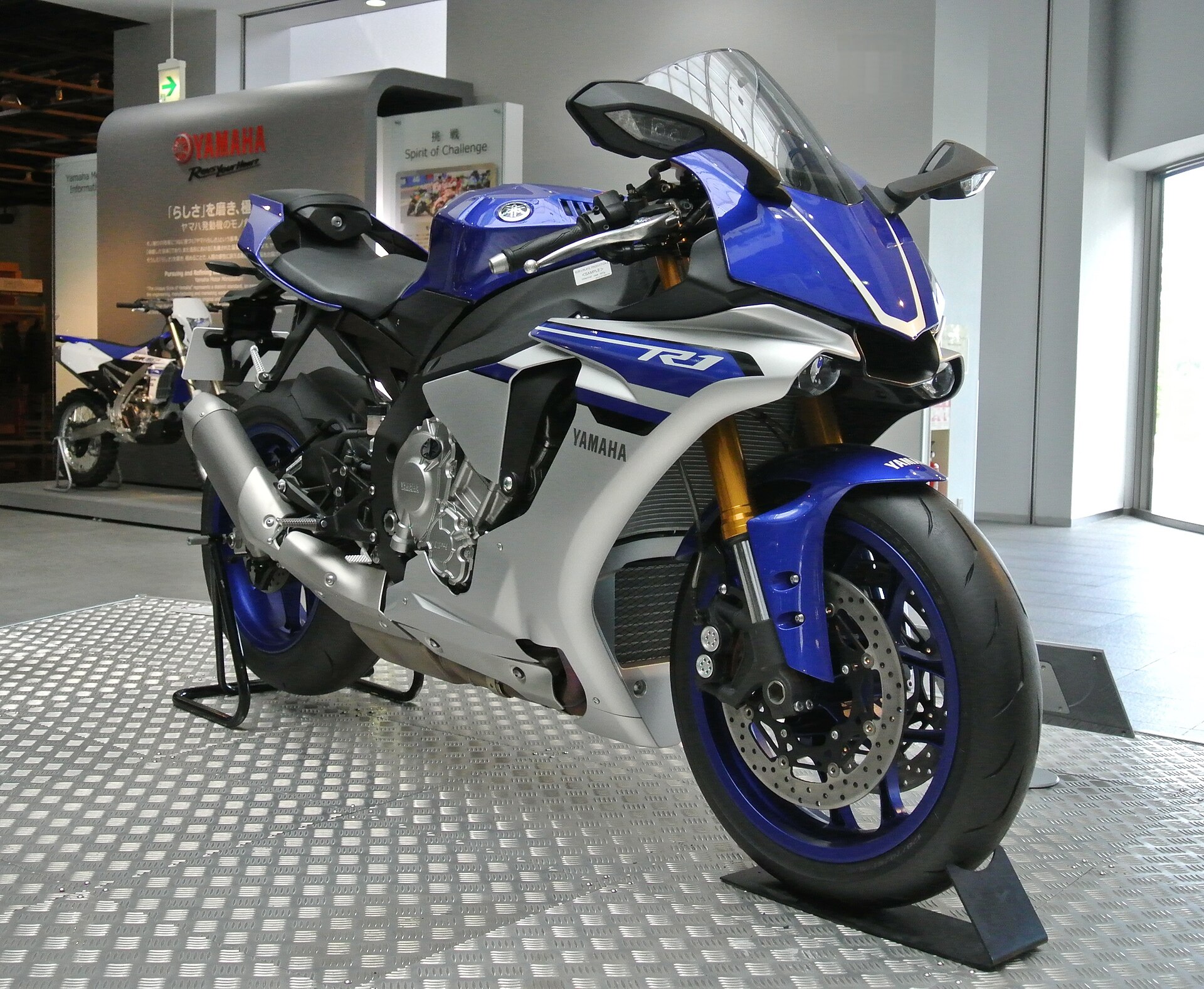
While European rivals chase ever-higher horsepower and ever-larger wings, two Japanese icons soldier on with quiet dignity. The Yamaha YZF-R1 and the Suzuki GSX-R1000R are the elder statesmen of the litre class — machines whose fundamental designs predate the current electronics arms race, yet which remain devastatingly capable and, crucially, attainable to riders who could never justify European exotica.
Both make around 200 hp, both have carried riders to world titles, and both offer a riding experience rooted in feel rather than gimmickry. The question is not whether they can still cut it — they emphatically can — but which of these old-guard warriors best rewards a rider today, in a world that increasingly prizes electronic wizardry over mechanical soul.
Engine and character
The R1’s crossplane inline-four is its signature. That uneven firing order gives it a burbling, V-twin-like snarl at low revs before it erupts into a banshee wail near the 13,500 rpm redline, producing roughly 200 hp. It feels connected and analogue, the throttle relaying grip information with rare honesty. The Suzuki’s 999.8cc engine takes a different route to a similar peak: 202 hp helped by a clever variable valve system that fattens the mid-range so it pulls hard from surprisingly low down.
On track the R1 feels more exotic and demands commitment near the redline, punishing the timid but rewarding the brave. The GSX-R1000R is the friendlier road engine, its broader torque curve and 118 Nm making it flexible and forgiving on real routes where you rarely see the top of the rev range. One rewards aggression; the other rewards patience. Both are gloriously, licence-threateningly fast.
Chassis and handling
Yamaha’s aluminium Deltabox frame and magnesium subframe make the R1 feel taut and razor-edged, happiest when hurled at an apex by a confident rider with clear intent. The GSX-R1000R answers with Suzuki’s balanced, planted chassis and superb Showa Balance Free forks that deliver remarkable feel over bumps. It is arguably the more forgiving, more communicative package on an imperfect surface, whereas the R1 is the sharper instrument in genuinely expert hands.